
You Graduated with a Diploma. Now What If Germany Was Your Next Move?
Most Indian polytechnic graduates face the same crossroads: pursue a B.Tech, hunt for a local job, or settle into a routine that feels smaller than your ambition. But there is a fourth option that most career counselors in India rarely talk about — and it could change everything.
Germany is running out of skilled workers. Officially. The German Federal Institute for Vocational Education and Training (BIBB) reports a shortage of hundreds of thousands of qualified tradespeople, technicians, and IT professionals. The country’s response? Open the doors wider — specifically through a structured, government-backed training program called Ausbildung.
And if you hold a 3-year Polytechnic Diploma from a technical institution like Diviseema Polytechnic, you are far better positioned to enter this program than you might think.
This guide is written specifically for you — whether you studied Mechanical, Civil, CSE, AIML, ECE, Automobile, or Metallurgy. We break down exactly how Ausbildung works in 2026, what it pays, how to apply, and what the realistic path to a German PR looks like.
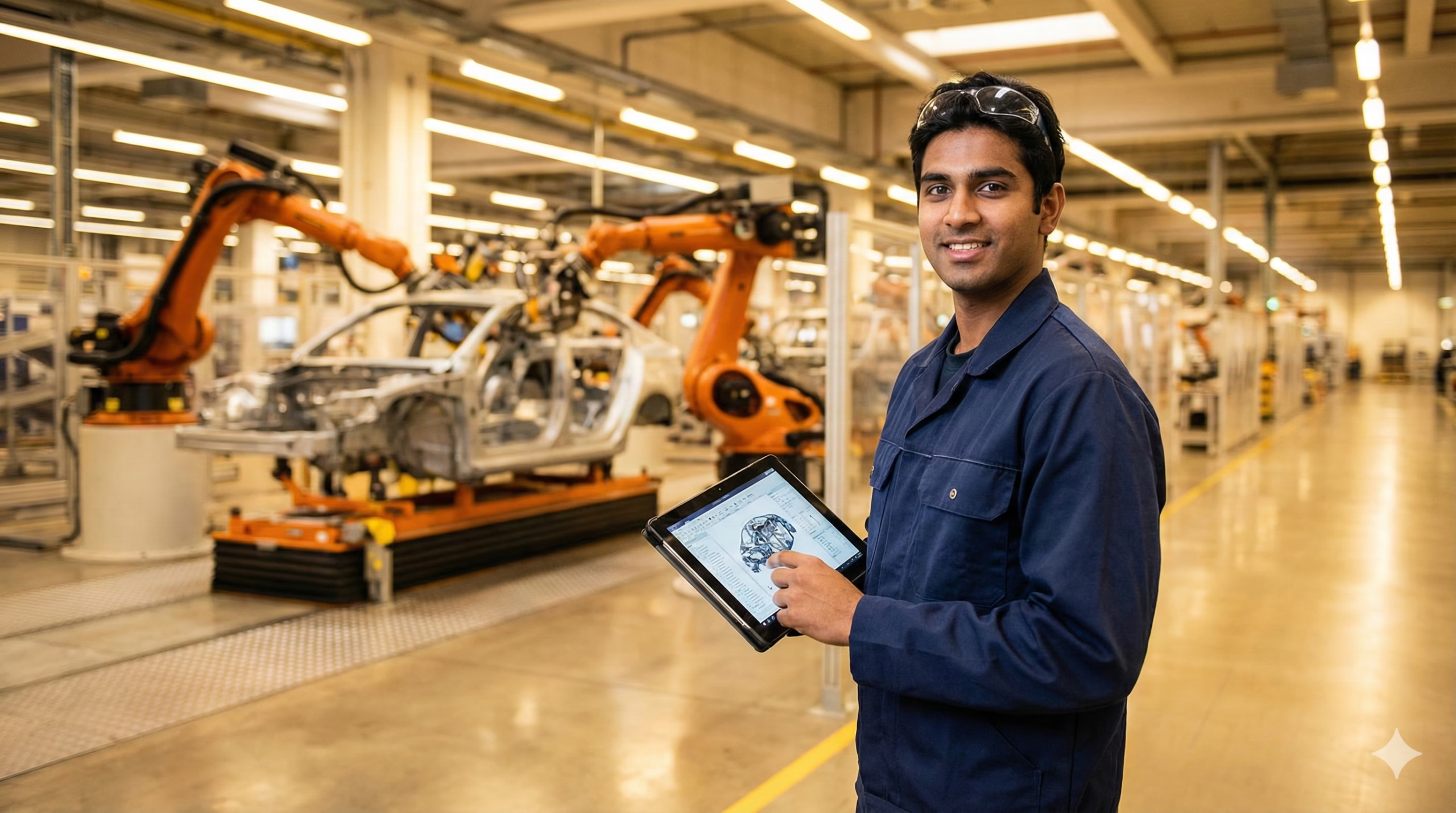
What Exactly Is Ausbildung? (And Why It’s Not Just “Training”)
Ausbildung (pronounced ows-bil-doong) is Germany’s Dual Vocational Education and Training (DVET) system. The word simply means “education” or “training” in German, but the program is anything but simple in its outcomes.
Here is how it works in practice:
- You split your time between a real employer (approximately 70% of the time) and a vocational school called Berufsschule (roughly 30% of the time).
- The duration is typically 2 to 3.5 years, depending on the profession.
- You are not an intern. You are a legally contracted apprentice with full worker protections, paid monthly, and contributing to Germany’s social security system from day one.
- At the end, you receive a state-recognized German vocational qualification — respected across all EU countries.
This is not a degree. It is arguably more valuable than one in Germany’s labor market for skilled trades and technical roles.
Why 2026 specifically? Germany’s Skilled Immigration Act (Fachkräfteeinwanderungsgesetz), which was significantly upgraded in 2023 and continues to be refined, has made it dramatically easier for non-EU nationals to enter Germany for Ausbildung. Processing times are being cut, recognition pathways are clearer, and German employers are actively searching for motivated candidates from India. The window is open right now.
Why Choose Ausbildung Over Going Back for a B.Tech?
This is a fair question, and it deserves a direct answer.
No Tuition Fees — Ever
Unlike a B.Tech, a Master’s degree, or studying in countries like the UK, Canada, or Australia, Ausbildung has zero tuition fees. The Berufsschule is state-funded. Your employer pays for your on-the-job training. You walk in with your diploma and your German skills. Nothing more.
You Get Paid to Learn
In 2026, Ausbildung stipends (called Ausbildungsvergütung) vary by sector and region, but the general range for technical and IT fields is:
- Year 1: €700 – €1,000/month
- Year 2: €850 – €1,150/month
- Year 3: €950 – €1,300+/month
Automotive and industrial sectors, driven by strong trade unions like IG Metall, tend to pay at the higher end. IT apprenticeships at medium-to-large tech companies in cities like Munich, Hamburg, or Stuttgart have been crossing €1,200/month in the final year consistently.
This isn’t “pocket money.” For a single person living in a smaller German city, this is enough to cover rent, food, transport, and still save modestly — without taking a single rupee of education loan.
A Direct Road to Permanent Residence
Germany’s immigration law is among the most straightforward in Europe when it comes to rewarding people who complete vocational training in-country. After finishing your Ausbildung and working in your qualified role for a set number of years, you can apply for:
- Niederlassungserlaubnis (Permanent Settlement Permit)
- EU Blue Card (if your post-Ausbildung salary crosses the threshold)
- Eventually, German citizenship after 5–8 years of legal residence
You are not gambling on a post-study work visa lottery. You are building a legally structured career path in one of Europe’s most stable economies.
Which Ausbildung Is Right for Your Diploma Branch?
This is where your Diviseema Polytechnic diploma becomes a genuine asset. German employers value prior technical education — they are not starting from zero with you. Here is how the major branches map to in-demand German Ausbildung roles:
Mechanical Engineering Diploma
→ Industriemechaniker (Industrial Mechanic) One of the most recruited Ausbildung roles in Germany. You will work with production machinery, carry out maintenance, and troubleshoot mechanical systems. Your diploma-level understanding of machine elements, manufacturing processes, and workshop practice gives you a direct foundation.
→ Zerspanungsmechaniker (Cutting Machine Operator/CNC Machinist) If you have hands-on CNC or lathe experience from your polytechnic labs, this role is a strong match.
Automobile Engineering Diploma
→ Kfz-Mechatroniker (Automotive Mechatronics Technician) Germany’s auto industry — Volkswagen, BMW, Mercedes-Benz, Bosch — recruits Kfz apprentices in thousands every year. Your knowledge of vehicle systems, engines, and automotive electronics from your diploma puts you ahead of general candidates. This is arguably the best-matched Ausbildung for automobile diploma holders.
Computer Science / AIML Diploma
→ Fachinformatiker – Anwendungsentwicklung (Application Development) Software development, scripting, database management — if you have learned programming, web technologies, or software design, this is your path.
→ Fachinformatiker – Systemintegration (System Integration) Networking, server management, IT infrastructure — closer to the hardware and systems side of your CSE curriculum. Germany’s Mittelstand (mid-sized companies) actively recruit for this role.
→ Kaufmann für IT-Systemmanagement (for those interested in the business-technical interface)
Civil Engineering Diploma
→ Bauzeichner (Construction Draftsman/Technical Drafter) Your exposure to AutoCAD, building plans, and structural drawing during your diploma is directly applicable. German construction firms need people who can read, draft, and communicate technical drawings.
→ Vermessungstechniker (Surveying Technician) If your diploma included land surveying, total station work, or GIS basics, this is a niche but well-paying Ausbildung option.
Electrical / Electronics / ECE Diploma
→ Elektroniker für Betriebstechnik (Electronics Technician for Industrial Operations) Maintaining and installing electrical systems in industrial facilities. Your circuit theory, PLC basics, and electrical lab work from the polytechnic translates directly.
→ Mechatroniker (Mechatronics Technician) A hybrid role combining mechanical, electrical, and IT systems. Excellent fit for ECE graduates who also covered mechanical subjects.
Metallurgy Diploma
→ Verfahrensmechaniker für Hütten- und Halbzeugindustrie (Process Mechanic – Metallurgy) A niche but remarkably well-matched role in German foundries and steel processing industries. Very few Indian applicants target this — which means lower competition and genuinely interested employers.
Eligibility Criteria for Indian Students in 2026
Let’s be honest about what you need. There are no shortcuts here, but the requirements are achievable.
Academic Qualification
- Completed 10th and 12th (or equivalent) plus a 3-year Polytechnic Diploma from a recognized institution.
- Your diploma must be from a state-recognized board (Andhra Pradesh State Board of Technical Education qualifies).
- You do not need a B.Tech. In fact, your diploma can be recognized in Germany as equivalent to a vocational qualification, which may actually reduce your Ausbildung duration by 6–12 months through a process called Anrechnung (recognition of prior learning).
German Language Proficiency — The Non-Negotiable
Here is the hard truth, stated plainly: without German, nothing else matters.
You cannot get the visa without it. You cannot function in the Berufsschule without it. Your employer cannot communicate with you on the factory floor or in the IT department without it.
The minimum accepted level for most Ausbildung programs is B1 (Intermediate). However, in 2026, with competition increasing, many competitive employers and visa-friendly Ausbildung positions are actively preferring B2 (Upper Intermediate) candidates.
B1 means you can hold a basic conversation, understand instructions, and write a simple email in German. B2 means you can participate in meetings, read technical documents, and express yourself with reasonable fluency.
How long does it take? Starting from zero, reaching B1 realistically takes 6–10 months of consistent, daily study. B2 takes 12–18 months. Factor this into your 2026 planning calendar immediately.
Accepted certifications: Goethe-Institut, ÖSD, telc, or TestDaF (TestDaF is more for university, but still valid).
Age
There is no strict legal age limit for Ausbildung in Germany. However, the realistic sweet spot is 18 to 30 years. Employers designing apprenticeship programs do tend to prefer younger candidates, but motivated candidates up to 35 regularly secure positions, especially in trades and IT.
Other Requirements
- A valid passport.
- Clean background (no criminal record).
- Basic health insurance coverage (provided or arranged post-arrival).
- Willingness to relocate within Germany — smaller cities in Bavaria, Baden-Württemberg, or Lower Saxony often have more openings and lower competition than Berlin or Munich.
Step-by-Step Application Process for 2026
This is the part where most guides become vague. We will not do that.
Step 1: Start Learning German — Today, Not Next Month
Download the Goethe-Institut’s study materials, enroll in a local German language institute, use DW Learn German (free online), and supplement with apps like Babbel or Pimsleur for daily practice. Set a realistic milestone: B1 by Month 9, B2 by Month 15. Do not move to the next steps until you are consistently at B1 level.
Step 2: Build a German-Style CV and Anschreiben
Indian CVs and German CVs are completely different documents.
A Europass CV or standard German Lebenslauf is structured, photo-included (yes, a professional photo is standard and expected in Germany), and lists education and work experience in reverse chronological order. It is typically one page.
The Anschreiben (cover letter) is a formal, half-page document addressed to a specific person at the company. It explains why you want this Ausbildung at this company. Generic letters are immediately discarded. Research the company before you write.
Use the Europass CV builder at europass.europa.eu — it is free and produces a recognized format.
Step 3: Get Your Diploma Recognized
This step surprises many applicants. Germany requires that your foreign qualification be assessed before or during the visa process.
- Visit the Anabin database (anabin.kmk.org) — this is Germany’s official database for evaluating foreign qualifications. You can check if your Indian diploma board is listed and at what recognition level.
- For formal recognition, contact the ZAB (Zentralstelle für ausländisches Bildungswesen) or a sector-specific recognition authority (like the Chamber of Crafts for trade roles).
- Your Ausbildung employer can also assist with this. Many do.
Step 4: Find and Apply for Ausbildung Positions
The best platforms for job searching in 2026:
- Make-it-in-Germany.com — Germany’s official government portal for international skilled worker immigration. Has a dedicated Ausbildung section.
- Ausbildung.de — One of Germany’s largest Ausbildung job boards.
- Azubi.de — Strong in industrial and technical Ausbildung roles.
- LinkedIn — Search “Ausbildung 2026” and filter by Germany. Many mid-size companies post here.
- IHK (Industrie- und Handelskammer) Job Exchanges — Chamber of Commerce listings by region.
- Direct company websites — BMW, Bosch, Volkswagen, Siemens, SAP, Deutsche Bahn, and hundreds of Mittelstand firms post Ausbildung positions on their careers pages every autumn and spring.
Application seasons: Most Ausbildung positions begin on 1st September each year. Start applying 8–12 months before your target start date. For September 2026, applications should ideally begin by October–November 2025.
Step 5: Prepare for the Online Interview
If shortlisted, expect a video interview in German. This is another reason B1/B2 is non-negotiable — you will be asked why you want to work at their company, what you know about the role, and basic questions about your background.
Practice common interview questions in German. Prepare a short self-introduction (Selbstvorstellung) of 2–3 minutes in German. Practice it until it sounds natural, not memorized.
Some employers also conduct a Einstellungstest — a written aptitude test covering math, logic, and sometimes basic technical knowledge. Polytechnic students handle these comfortably.
Step 6: Sign the Training Contract and Apply for the Visa
Once an employer selects you, they will issue a training contract (Ausbildungsvertrag). This is the single most important document for your visa application.
With the contract in hand, apply for the German National Visa for Vocational Training at the German consulate in Chennai, Mumbai, or New Delhi.
Required documents typically include:
- Completed visa application form
- Valid passport
- Signed Ausbildungsvertrag
- Proof of German language proficiency (Goethe/ÖSD certificate)
- Educational certificates (diploma, 10th, 12th marksheets, authenticated)
- Proof of accommodation in Germany (employer-arranged or a rental contract)
- Health insurance coverage
- Passport-sized photographs
Processing time: Generally 8 to 12 weeks from submission. Apply early.
Financial Planning: Visa, Blocked Accounts, and Living Costs
This section clears up a lot of confusion.
Do You Need a Blocked Account?
The German visa requirement for students typically mandates a blocked account (Sperrkonto) of around €11,208/year (approximately €934/month) to prove you can support yourself. However, Ausbildung applicants are treated differently from students.
If your Ausbildungsvertrag clearly shows a stipend that meets or exceeds the living cost threshold (roughly €934/month), many German consulates will accept the contract itself as proof of financial self-sufficiency — no blocked account needed. However, this varies by consulate and individual case.
Our recommendation for 2026: Even if your stipend is €900+/month, consult your nearest German consulate or a certified immigration advisor to confirm their specific current requirement. Having €2,000–€3,000 in savings as a buffer is wise regardless.
Approximate Monthly Living Costs in Germany (2026)
Your actual expenses will depend heavily on whether you live in a large city or a smaller town. Smaller cities are significantly cheaper:
- Rent (shared apartment/WG): €300–€600/month
- Groceries: €150–€250/month
- Transport (public): €30–€80/month (many employers cover the Deutschlandticket)
- Health insurance: Often covered by your employer during Ausbildung
- Phone + internet: €30–€50/month
- Miscellaneous: €100–€150/month
A realistic total: €650–€1,100/month, leaving most Ausbildung students with a modest but genuine surplus in the second and third year of their training.
Life After Ausbildung: What the Numbers Look Like
Once you complete your Ausbildung, the German labor market opens up substantially.
- Kfz-Mechatroniker (qualified): €28,000–€38,000/year starting salary
- Fachinformatiker (IT): €32,000–€48,000/year, rising quickly with experience
- Industriemechaniker: €28,000–€36,000/year
- Elektroniker: €27,000–€35,000/year
After 2 years of employment in your trained field, you can apply for permanent residence (Niederlassungserlaubnis). IT professionals crossing €45,300/year in 2026 qualify for the EU Blue Card — Europe’s fast-track permanent residency for skilled workers.
The math is straightforward: you enter with zero debt, train for 2–3 years while earning, qualify with a German-recognized credential, and enter the workforce with a path to permanent residence already visible. Compare that to a 4-year B.Tech plus a 2-year Master’s abroad plus an education loan of ₹30–50 lakhs and a post-study visa lottery.
The Honest Challenge You Should Know About
This guide would be incomplete without stating this clearly: Ausbildung is not easy, and it is not fast.
Learning German to B2 level takes serious commitment — typically 1–1.5 years of consistent effort. The cultural adjustment to German workplace norms (punctuality is not just valued, it is expected; directness in communication is normal, not rude) takes time. Homesickness is real. The early months on a stipend in a foreign country, working and studying simultaneously in a second language, are genuinely demanding.
But here is what is also true: thousands of Indian professionals have walked this path and built stable, dignified careers in Germany. The system is designed to support you once you are in it. German employers who hire international apprentices know what they are getting into — they want you to succeed because training you is an investment for them too.
Start Here: Your 2026 Ausbildung Action Plan
If you are a current student or a recent diploma graduate at Diviseema Polytechnic, here is what the next 12–18 months look like if you are serious about this path:
Months 1–9: Begin German language classes, target B1 certification. Build your Europass CV. Start researching Ausbildung roles that match your branch.
Months 9–14: Clear B1. Begin B2 preparation simultaneously. Start applying to Ausbildung positions on Ausbildung.de, Make-it-in-Germany.com, and direct company portals. Target September 2026 intake.
Months 14–18: Interview rounds, contract negotiation, document preparation for visa. Apply for visa 3–4 months before your intended travel date.
Conclusion: A Debt-Free Career in Europe Is Within Your Reach
Germany’s Ausbildung program is one of the most underrated international opportunities available to Indian polytechnic diploma holders today. It asks for your time, your German language effort, and your technical competence — all things that a Diviseema Polytechnic diploma has either given you or prepared you to develop.
The payoff is real: a recognized qualification, a living wage during training, no tuition debt, legal work rights in the EU, and a concrete path to permanent residence. Not in 10 years. Not after three visa rejections and two expensive master’s degrees. In 4–5 years of focused, disciplined effort.
The question is not whether the opportunity exists. It clearly does. The question is whether you are ready to learn the language that unlocks it.
Take the Next Step with Diviseema Polytechnic
Want more career guides like this — covering opportunities in Japan, Australia, Canada, Gulf countries, and more for Indian diploma holders? Visit the Diviseema Polytechnic Hub for regularly updated career resources, study guides, and industry insights tailored specifically for technical diploma students.
Already a Diviseema Polytechnic student or alumni? Reach out to our Campus Career Guidance Cell directly. Our counselors can advise you on language learning resources available on campus, help you assess which Ausbildung role aligns with your branch and skill set, and connect you with upskilling programs that strengthen your profile for international applications.
Your diploma is just the beginning. Where it takes you is entirely up to you.
Last updated: 2026 | Sources: German Federal Institute for Vocational Education and Training (BIBB), Federal Employment Agency (BA), Make-it-in-Germany.com, German Embassy India.
Author
Discover more from Diploma Polytechnic Education Hub
Subscribe to get the latest posts sent to your email.


