
Top Companies Hiring Diploma Engineers in Gulf Countries: The Complete 2026 Guide for Indian Polytechnic Graduates
Every month, over 18,000 Indian polytechnic diploma holders land jobs in the Gulf — many of them earning 3 to 5 times what they would make back home, completely tax-free. Yet most diploma graduates applying to the Gulf have no idea which companies are actually hiring, what salary they can realistically expect, or why their applications keep getting rejected.
If you hold a diploma in Mechanical, Civil, Electrical, or Electronics Engineering and you’re serious about working in UAE, Saudi Arabia, Qatar, or Kuwait in 2026, you’ve just found the only guide you’ll need.
📌 TL;DR — Key Takeaways (Read This First)
- Gulf countries are actively hiring diploma engineers in 2026, especially for construction, oil & gas, MEP (Mechanical, Electrical & Plumbing), and facilities management sectors.
- Diploma holders earn AED 2,500–AED 6,000/month (approx. ₹56,000–₹1,35,000/month) tax-free in the UAE — plus free accommodation, food, and flights in most packages.
- Saudi Arabia and Qatar offer higher gross salaries but UAE has stronger long-term career growth and lifestyle benefits.
- The single biggest mistake most Indian diploma engineers make: applying through unverified agents and paying “visa fees.” Legitimate Gulf employers NEVER charge candidates.
- Companies like L&T, Shapoorji Pallonji, Emaar, ADNOC contractors, QatarEnergy contractors, and KNPC are among the largest recruiters of Indian diploma engineers in 2026.
- You do not need a degree to qualify — but certifications like AutoCAD, NEBOSH, and OSHA significantly boost your salary and hire chances.
- The eMigrate portal (Government of India’s official emigration system) must be used for ECR passport holders applying to Gulf jobs.
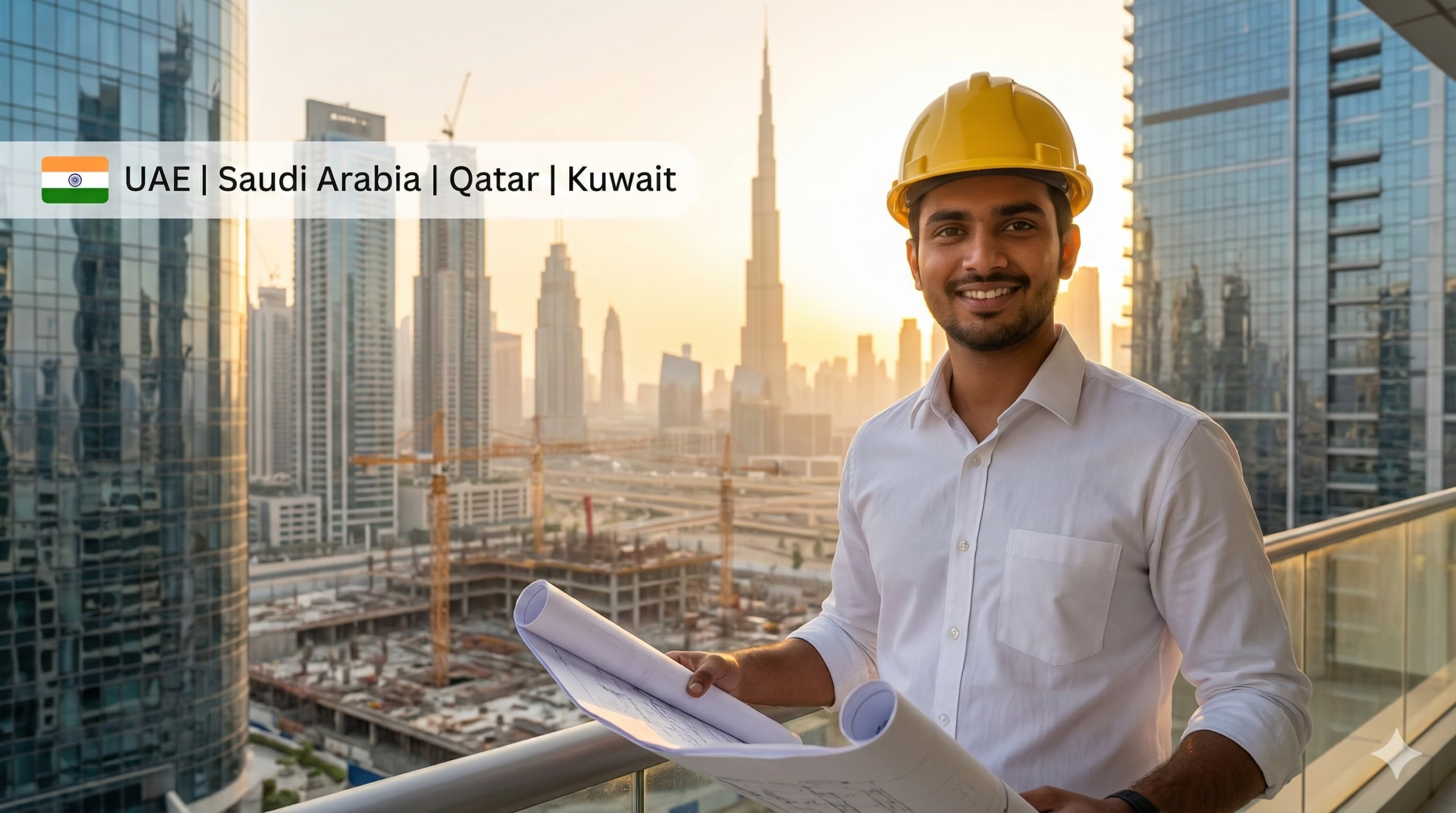
Why Gulf Countries Are Still the #1 Destination for Diploma Engineers in 2026
Let’s be clear about something: the Gulf hiring boom is not slowing down. If anything, it is accelerating.
Saudi Arabia’s Vision 2030 alone has over $1.3 trillion worth of mega-projects under construction — NEOM, Red Sea Project, Diriyah Gate, and King Salman Airport are just the beginning. Qatar is expanding its LNG infrastructure post-World Cup. The UAE is building its way through an urban transformation that would make your head spin.
Every one of these projects needs thousands of technically skilled workers. And diploma engineers — not degree holders — fill the critical mid-tier supervisory, technical, and maintenance roles that keep these sites running.
Suresh from Coimbatore, a diploma holder in Civil Engineering, is a perfect example. He applied through a NASSCOM-registered recruitment agency in 2023, cleared a basic technical interview, and joined a construction firm in Abu Dhabi. By 2025, he was earning AED 4,500/month (approximately ₹1,02,000/month) with free accommodation and one return flight per year. His total savings in two years exceeded ₹14 lakhs — something that would have taken him 5–6 years to save in India.
Top Companies Actively Hiring Diploma Engineers in Gulf Countries (2026)
Here is a verified list of companies — both Indian and international — that regularly recruit Indian polytechnic diploma holders for Gulf postings.
🏗️ Construction & Infrastructure
Larsen & Toubro (L&T) is arguably the single largest recruiter of Indian diploma engineers for Gulf projects. L&T has active project sites in Saudi Arabia, UAE, Qatar, and Kuwait. They regularly post openings for Site Engineers, Supervisors, MEP Technicians, and Quality Control Assistants. Their Gulf projects include NEOM infrastructure packages and Qatar North Field expansion support work.
Shapoorji Pallonji is another Indian construction giant with a strong Gulf presence. They hire Civil and Structural diploma holders for site supervision, quantity surveying support, and quality inspection roles. Their UAE operations are among their most active globally.
Tata Projects has significant construction contracts in Saudi Arabia and UAE, especially in industrial and infrastructure verticals. Diploma engineers in Mechanical and Civil branches are frequently recruited for project execution roles.
⚙️ Oil, Gas & Energy
ADNOC (Abu Dhabi National Oil Company) Contractors — ADNOC itself hires degree engineers, but its vast network of EPC (Engineering, Procurement, and Construction) contractors like Petrofac, Technip Energies, McDermott, and Saipem regularly recruit diploma engineers for instrumentation, electrical maintenance, and piping roles.
Saudi Aramco Contractors — Similar model applies here. Companies like Archirodon, NPCC, and Samsung Engineering operate on Aramco project sites and hire diploma-qualified technicians and junior engineers from India. Aramco’s continued expansion into new gas fields, field enhancement projects, and carbon capture technologies ensures robust recruitment across multiple domains through 2026. Farmonaut®
QatarEnergy Contractors — QatarEnergy is leading recruitment efforts in 2026, expanding LNG production and upgrading offshore platforms, with companies like McDermott International, Technip Energies, and Saipem actively participating and recruiting internationally. HSE STUDY GUIDE
Kuwait National Petroleum Company (KNPC) hires through authorized recruitment agents in India for roles including Electrical Technicians, Instrumentation Supervisors, and Mechanical Maintenance Workers.
🏢 Real Estate, Facilities & MEP
Emaar Properties (UAE) and its facilities management arm hire MEP diploma holders — particularly Electrical and A/C Technicians — for ongoing property management across its massive portfolio of Dubai properties.
Transguard Group (UAE) is a significant employer of facilities management and technical staff, including diploma-qualified electrical and mechanical engineers.
Khansaheb Civil Engineering and Al-Futtaim Engineering are two UAE-based firms that actively recruit Indian diploma holders for MEP, civil finishing, and HVAC maintenance roles.
🔌 Manufacturing & Industrial
Borouge (Abu Dhabi) — a petrochemical company — and SABIC (Saudi Arabia) recruit diploma engineers in Chemical, Mechanical, and Instrumentation for plant operations and maintenance technician roles.
Honeywell (Gulf operations) regularly recruits Instrumentation and Electronics diploma holders for service engineer and technical support roles across its Gulf client sites.
Gulf Salary Comparison for Diploma Engineers (2026)
This is the table every diploma engineer needs to bookmark.
📊 Table 1: Diploma Engineer Monthly Salary by Country and Branch (2026)
| Branch | UAE (AED/month) | UAE (₹/month approx.) | Saudi Arabia (SAR/month) | SAR (₹/month approx.) | Qatar (QAR/month) | QAR (₹/month approx.) | Kuwait (KWD/month) | KWD (₹/month approx.) |
|---|---|---|---|---|---|---|---|---|
| Civil Engineering | 3,000–5,500 | ₹67,500–₹1,24,000 | 2,500–4,500 | ₹55,500–₹1,00,000 | 2,800–5,000 | ₹63,000–₹1,13,000 | 120–220 | ₹32,000–₹59,000 |
| Mechanical Engineering | 3,000–6,000 | ₹67,500–₹1,35,000 | 2,800–5,000 | ₹62,000–₹1,11,000 | 3,000–5,500 | ₹67,500–₹1,24,000 | 130–240 | ₹35,000–₹65,000 |
| Electrical Engineering | 2,500–5,500 | ₹56,000–₹1,24,000 | 2,500–4,800 | ₹55,500–₹1,06,000 | 2,800–5,200 | ₹63,000–₹1,17,000 | 120–230 | ₹32,000–₹62,000 |
| Electronics/Instrumentation | 3,000–6,000 | ₹67,500–₹1,35,000 | 3,000–5,500 | ₹66,500–₹1,22,000 | 3,200–5,800 | ₹72,000–₹1,31,000 | 140–260 | ₹38,000–₹70,000 |
| Chemical/Process | 3,500–7,000 | ₹78,750–₹1,57,500 | 3,500–6,500 | ₹77,700–₹1,44,000 | 3,800–7,000 | ₹85,500–₹1,57,500 | 150–280 | ₹40,500–₹75,500 |
Sources: GulfTalent, Indeed UAE, Naukrigulf, Glassdoor (data as of January–February 2026). Conversion rate used: 1 AED = ₹22.50, 1 SAR = ₹22.20, 1 QAR = ₹22.50, 1 KWD = ₹270. These are approximate and subject to market fluctuation.
⚠️ Insider Warning: Most Gulf job offers include allowances beyond the base salary — housing allowance, transport allowance, annual airfare, and medical insurance. When comparing offers, always calculate the Total Cost to Company (CTC) — not just the base. A lower base salary with full accommodation and flights can easily be worth more than a higher base with no benefits.
📊 Table 2: Top Hiring Companies — Roles, Minimum Qualification & Apply Channel (2026)
| Company | Country | Typical Roles for Diploma Holders | Minimum Experience | Apply Via |
|---|---|---|---|---|
| Larsen & Toubro (L&T) | UAE, KSA, Qatar | Site Engineer, MEP Supervisor, QC Technician | 0–2 years | careers.larsentoubro.com |
| Shapoorji Pallonji | UAE, KSA | Civil Site Supervisor, Structural Inspector | 1–3 years | careers.shapoorji.com |
| Tata Projects | UAE, KSA | Project Support Engineer, Civil Technician | 1–2 years | careers.tataprojects.com |
| McDermott International | KSA, Qatar | Piping Technician, E&I Fitter | 2–4 years | mcdermott.com/careers |
| Technip Energies | Qatar, UAE | Instrumentation Tech, Process Technician | 2–5 years | technipfmc.com/careers |
| Emaar Properties | UAE | MEP Technician, HVAC Technician | 1–3 years | careers.emaar.com |
| SABIC | KSA | Plant Operator Trainee, Maintenance Tech | 0–2 years | sabic.com/careers |
| Al-Futtaim Engineering | UAE | Electrical/A/C Technician, Civil Supervisor | 1–3 years | alfuttaim.com/careers |
| KNPC Contractors | Kuwait | Electrical Technician, Instrumentation Tech | 3–5 years | Through authorized Indian agents |
| Transguard Group | UAE | Technical Engineer, Facilities Technician | 1–2 years | transguard.ae/careers |
Source: Official company career portals and verified job listings on Bayt.com, Naukrigulf, GulfTalent (2025–2026)
How to Get Hired: A Step-by-Step Process for Indian Diploma Engineers
This is the process that actually works — not what agents tell you.
Step 1: Prepare your documents. You’ll need your polytechnic diploma certificate (attested by your state government and MEA — Ministry of External Affairs), mark sheets, experience certificates if any, a passport valid for at least 2 years, and passport-size photographs. Get your documents attested early — this alone can take 3–6 weeks.
Step 2: Build a Gulf-format resume. A Gulf CV is different from an Indian resume. It should be 2 pages maximum, include your photo, nationality, and visa status, and list all technical skills and software proficiency (AutoCAD, SAP, MS Project, etc.) prominently. There are free Gulf CV templates available on Bayt.com and Naukrigulf.
Step 3: Register on verified job portals. Create profiles on Bayt.com, Naukrigulf.com, GulfTalent.com, and LinkedIn. Set job alerts for your discipline and target countries. Also check the direct career pages of the companies listed above weekly.
Step 4: Check eMigrate status. If you hold an ECR (Emigration Check Required) passport — which most Indian diploma holders do — you MUST register on the eMigrate portal (emigrate.gov.in) run by the Ministry of External Affairs before working in Gulf countries. Your employer will submit an Emigration Clearance request on your behalf through a registered recruiter. This is a legal requirement, not optional.
Step 5: Apply only through verified channels. Apply directly through official company career portals or through NASSCOM/AIIA-registered recruitment agents. You can verify registered agents on the Protector General of Emigrants website (mea.gov.in/emigration). Never pay money to get a Gulf job. Legitimate companies bear all visa and relocation costs.
Step 6: Prepare for technical interviews. Gulf employers conduct technical interviews either in India (through their recruitment drives or authorized agents) or online. Prepare for practical questions in your discipline — pipe fitting, reading electrical drawings, AutoCAD commands, or material testing procedures. Practice describing your actual work experience clearly in English.
Step 7: Medical and visa processing. Once you receive an offer letter, your employer will arrange a pre-departure medical examination through their authorized medical center (check MOH UAE or Saudi Aramco approved clinics). The work visa will then be stamped in your passport, typically within 4–8 weeks.
Which Gulf Country Is Best for Diploma Engineers in 2026?
This is the question Mohammed from Hyderabad — a Mechanical Diploma holder — asked before accepting his first Gulf offer. Here is an honest answer.
UAE offers the best overall package for first-time Gulf workers: stronger labour law protections, easier travel, more social freedom, and clear career progression pathways. Dubai and Abu Dhabi specifically have a massive and growing construction and facilities management sector. The downside is that the cost of living, especially outside employer-provided housing, is high.
Saudi Arabia offers higher gross salaries in oil & gas and mega-projects, but lifestyle restrictions and the remote nature of many project sites can be challenging for first-timers. However, Vision 2030 projects mean more urban, modern work environments are emerging. Tax-free salaries, accommodation and travel allowances, and global exposure make Saudi Arabia attractive for professionals across oil & gas, construction, maintenance, MEP, and industrial projects in 2026. Gulfjobfind
Qatar has strong demand, particularly in LNG and infrastructure. Salaries are competitive and the country has invested heavily in improving worker welfare following the World Cup spotlight. For diploma engineers in oil & gas disciplines, Qatar deserves serious consideration.
Kuwait is often overlooked but offers solid opportunities in petrochemicals, refining, and civil construction. Salaries are competitive and the cost of living is somewhat lower than UAE. KNPC and Kuwait Oil Company (KOC) contractor projects regularly absorb Indian technicians.
💡 Expert Insight — Counselor’s Note
What most students don’t know: The fastest way into a Gulf company is not through a job portal — it’s through an Indian company’s Gulf project division. L&T, Shapoorji, Tata Projects, and Afcons Infrastructure all have Indian HR teams that conduct Gulf recruitment drives in polytechnic cities like Coimbatore, Hyderabad, Pune, and Ahmedabad 2–3 times per year. These drives are announced on their official career pages and sometimes through college placement offices. If you’re a fresh diploma holder with zero Gulf experience, this is your most realistic entry point — because these companies trust Indian qualifications, handle your eMigrate clearance, and provide structured onboarding. Watch these portals and set alerts. One campus drive can change your career trajectory overnight.
Certifications That Dramatically Increase Your Gulf Hiring Chances
A diploma alone will get you shortlisted. Certifications will get you hired — and earn you ₹20,000–₹40,000 more per month.
AutoCAD Certification is nearly mandatory for Civil and Mechanical diploma engineers in Gulf construction roles. Get certified through Autodesk’s official platform or CADD Centre India.
NEBOSH IGC (International General Certificate in Occupational Health and Safety) opens up a whole new category of HSE (Health, Safety & Environment) roles. Most Gulf companies prefer NEBOSH IGC as a minimum qualification for safety roles, with salaries ranging from QAR 4,000 to QAR 6,000 for entry-level positions. HSE STUDY GUIDE Even non-safety engineers with NEBOSH earn salary premiums.
OSHA 30-Hour Certification is a US-recognized safety standard widely accepted by Gulf EPC contractors. It is affordable (approximately ₹8,000–₹15,000) and can be completed online.
PLC Programming (Siemens/Allen-Bradley) is a high-value skill for Electrical and Instrumentation diploma holders. Knowledge of PLC systems is specifically listed as an added advantage for electrical roles in Gulf oil & gas projects, especially for shutdown and maintenance work. GULF TODAY JOBS
Welding Certifications (ASME/API) are highly valued for Mechanical diploma holders. Certifications in ASME/API standards are preferred by Gulf employers for welding roles, which are in high demand for shutdown projects due to extensive repair and fabrication work. GULF TODAY JOBS
Common Mistakes Indian Diploma Engineers Make When Applying to Gulf Jobs
Anitha from Vizag spent ₹1.5 lakhs on a “visa fee” to an agent who promised her a clerical job in Dubai. She never got the visa. This is one of the most common Gulf job scams in India and it is entirely avoidable.
Mistake 1: Paying money for a visa. Say this out loud: legitimate Gulf employers never charge visa fees to workers. If anyone asks you to pay for a visa, work permit, or “processing fee” to get a Gulf job, walk away immediately.
Mistake 2: Applying with an unattested diploma. Your polytechnic certificate needs state government attestation AND MEA (apostille) before it is valid in Gulf countries. Many applications are rejected because this was skipped.
Mistake 3: Ignoring eMigrate requirements. ECR passport holders who skip eMigrate clearance can be detained at the Gulf airport on arrival. This is not a formality — it is the law.
Mistake 4: Applying for jobs outside your qualification level. Many diploma engineers apply for “Engineer” roles that legally require a B.E./B.Tech degree in the Gulf. Apply for titles like “Junior Engineer,” “Technician,” “Supervisor,” or “Technical Assistant” — these are designed for diploma holders and offer clear promotion pathways.
Mistake 5: Neglecting English communication skills. Gulf workplaces are multilingual but English is the professional language. Invest 2–3 months in spoken English improvement before applying — it will directly impact your interview success rate and starting salary negotiation.
Government of India Resources for Gulf-Bound Diploma Engineers
The Government of India provides several important resources and protections for workers going to the Gulf.
The eMigrate System (emigrate.gov.in) is mandatory for ECR passport holders. It connects you with the Ministry of External Affairs and ensures your employer is verified before you travel. Never bypass this system.
The e-Migrate Smart system also allows you to verify if a foreign employer is registered and legitimate — a crucial check before accepting any offer.
The Indian Workers Resource Centre (IWRC) at mea.gov.in offers legal aid, distress support, and repatriation assistance for Indian workers abroad facing exploitation.
The Pravasi Bharatiya Bima Yojana (PBBY) is a government insurance scheme specifically for ECR-category workers going to 17 notified emigration countries including UAE, Saudi Arabia, Qatar, and Kuwait. The premium is just ₹275–₹375 per year for ₹10 lakh coverage. This is mandatory for ECR workers and genuinely protects your family.
FAQ: Gulf Jobs for Diploma Engineers — 8 Real Questions Students Ask
Q1. Can a diploma holder get a job in the Gulf without any work experience?
Yes, but it is more competitive. Indian construction companies like L&T, Shapoorji Pallonji, and Tata Projects do recruit fresh diploma holders through campus-linked Gulf project drives. For oil & gas companies, most roles require a minimum of 2–3 years of experience. Your best strategy as a fresher is to target construction and MEP roles, which have more entry-level openings. Getting 1–2 years of Indian project experience first dramatically increases your Gulf offer quality and starting salary.
Q2. How much does a diploma engineer earn in UAE in Indian rupees?
Diploma holders in electrical engineering in Dubai typically start with salaries ranging from AED 2,500 to AED 4,000 per month, which is approximately ₹56,000 to ₹89,000 per month. Terratern With experience and additional certifications, this can rise to AED 5,000–6,000/month (₹1,12,000–₹1,35,000). On top of this base, most packages include free accommodation, transport, and annual airfare — which effectively adds another ₹30,000–₹60,000/month in equivalent value.
Q3. What is the age limit for Gulf jobs for diploma engineers in 2026?
Most Gulf employers accept applications from diploma engineers aged 21 to 45 years. Some companies and countries have specific caps: Saudi Arabia typically prefers workers under 40 for fresh contracts, while UAE employers are generally flexible up to 45. If you are above 40, having strong relevant experience and certifications significantly helps your case.
Q4. How many days does it take to get a Gulf work visa after receiving an offer?
After you receive a formal offer letter and complete your medical examination, the visa stamping process typically takes 4 to 8 weeks. The overall process from application to departure — including document attestation, medical, and eMigrate clearance — usually takes 2 to 4 months. Plan accordingly and do not resign from your current job until your visa is physically stamped in your passport.
Q5. Which Gulf country is best for a fresher diploma engineer?
UAE is generally recommended for first-time Gulf workers because of stronger labour law protections, a more structured onboarding process at major companies, and easier access to Indian community support networks. Dubai and Abu Dhabi also offer more diverse industries, meaning if one sector slows down, you have options. Saudi Arabia and Qatar can offer higher salaries but are better suited to those with some Gulf or relevant Indian industry experience.
Q6. What documents do I need to apply for a Gulf job as a diploma engineer?
You need your original diploma certificate with state government attestation and MEA apostille, all mark sheets, experience certificates (if applicable), a valid Indian passport with at least 2 years validity, and passport-size photographs. For roles in oil & gas, safety certifications (NEBOSH, OSHA) and AutoCAD/technical software certifications should be included. Carry both originals and multiple self-attested photocopies of everything.
Q7. Is it safe to use recruitment agents for Gulf jobs?
It is safe only if you use NASSCOM or Ministry of External Affairs-registered recruitment agents. You can verify any agent’s registration on the Protector General of Emigrants portal (mea.gov.in). Never pay any agent more than the officially prescribed service charge — which is capped by the Government of India. Paying large sums (₹50,000+) is a strong indicator of a fraudulent agent.
Q8. Can a diploma engineer apply for a Gulf job directly without going through an agent?
Absolutely. All the major companies listed in this article have official career portals where you can apply directly. Registering on Bayt.com, Naukrigulf.com, and LinkedIn and applying through official company websites is not only free but also more credible than going through third-party agents. Direct applications are increasingly preferred by large Gulf employers who conduct their own India-based recruitment drives.
Conclusion: Your 3 Most Important Action Points for 2026
The Gulf opportunity for Indian diploma engineers is real, large, and open right now. But it goes to those who prepare properly — not those who wait.
Point 1: Start your document attestation process immediately — it is the longest step and the one most people procrastinate on. Get your diploma attested by the State Government and then apply for MEA apostille. This single step can take up to 6 weeks.
Point 2: Apply directly through official company career portals of L&T, Shapoorji, Tata Projects, McDermott, and Emaar — not through unknown agents. Set up job alerts for your discipline on Bayt.com and Naukrigulf today.
Point 3: Add at least one international certification to your profile before you apply — AutoCAD for civil/mechanical, NEBOSH IGC for safety-adjacent roles, or PLC programming for electrical/instrumentation. This single addition can increase your starting salary offer by 20–40%.
You have a real, valuable qualification. The Gulf is not looking for something you don’t have — it is looking for exactly what a well-prepared Indian polytechnic diploma holder offers: technical competence, strong work ethic, and practical skills. The only question is whether you will put in the preparation to be the candidate who gets the call.
Start today. Your Gulf career is one well-prepared application away.
Author
Discover more from Diploma Polytechnic Education Hub
Subscribe to get the latest posts sent to your email.


