Everyone wants to design the next Tesla.
Walk into any Polytechnic final-year classroom, ask the students where they want to work, and you’ll hear the same three answers: R&D, battery design, or manufacturing at a major OEM.
It makes sense. That’s where the glamour is. It’s what we see on LinkedIn.
But here is what I’ve learned after spending years watching industry trends and seeing where the actual hiring gaps are: The glamour roles are saturated. You are fighting against thousands of B.Tech and M.Tech graduates for a handful of design seats.
Meanwhile, there is a massive, silent crisis brewing in the industry. The cars are hitting the road, the charging stations are being installed, and fleets are switching to electric. But when these things break—and trust me, they break—there is almost nobody qualified to fix them.
This is your opportunity.
While everyone is fighting for the front door (design), the backdoor (maintenance and operations) is wide open. Let’s talk about the specific jobs in EV maintenance that are practically begging for skilled diploma holders right now.
The “Charger Down” Crisis (EVSE Technician)
Next time you pass a public charging station, take a look. There’s a decent chance one of the guns is out of order.
The infrastructure is rolling out faster than the support network. We call this the EVSE (Electric Vehicle Supply Equipment) gap. These units aren’t just fancy extension cords; they are high-powered computers that talk to the grid and the car simultaneously.
The Role: EVSE Maintenance Technician. The Work: Troubleshooting connectivity issues, replacing cooling fluid in high-speed chargers, fixing payment gateway hardware, and handling grid-side electrical faults.
Real-World Scenario
I recently spoke with a grid operator who was frantic. They had downtime penalties in their contract. If a charger is down for more than 4 hours, they lose money. They didn’t need a PhD in chemistry; they needed someone who knew how to use a multimeter and could read a basic network log.
- The Common Mistake: Thinking this is just “electrician work.”
- The Surprising Insight: 50% of charger failures are actually software or communication hand-shake errors. If you know basic networking (IP addresses, modems) alongside your electrical basics, you are a unicorn candidate.
- Actionable Step: Don’t just learn wiring. Familiarize yourself with the EVSE Technician Certification standards. Go online and read installation manuals for major charger brands. Learn what an “OCPP error code” is.
- Your Checklist:
- Get comfortable with 3-phase power safety.
- Learn basic Linux command line or networking diagnostics.
- Understand the difference between AC Level 2 and DC Fast Charging components.
The Fleet Maintenance Revolution (Last-Mile Logistics)
You’ve seen the blue and orange delivery vans and the electric scooters carrying food deliveries. These vehicles take a beating. They run 10 to 12 hours a day, effectively stress-testing every component in the powertrain.
These companies (logistics providers) cannot afford to send their vehicles back to the manufacturer for every little rattle. It takes too long. They are setting up in-house maintenance hubs, and they need floor supervisors.
The Role: Fleet Maintenance Supervisor / Lead Technician.
Case Study: The Scooter Pivot
Meet Arjun (name changed for privacy). He graduated with a Diploma in Automobile Engineering and initially tried to get into a car dealership. No luck. He took a contract job with a logistics startup that uses electric 2-wheelers. Initially, he just swapped tires and brake pads. The Shift: He noticed that drivers were burning out motors because they didn’t understand the regenerative braking settings. He tweaked the maintenance schedule to check the Controller logic every month. Breakdowns dropped by 30%. Where is he now? He manages the hub. He’s not dirtying his hands with grease anymore; he’s managing battery health metrics on a dashboard.
- The Common Mistake: Treating an EV fleet vehicle like an ICE vehicle. According to the Department of Energy’s guide on EV maintenance, you don’t need to change oil, but you do need to manage thermal paste, coolant loops, and software updates.
- Actionable Step: Look for job postings from logistics companies, not just car companies. Search for “Hub Manager” or “Fleet Technician.”
- The Insight: These jobs often pay better than junior engineering roles because they are operations-critical. If the bikes don’t run, the packages don’t move.
Thermal Management Systems (HVAC on Steroids)
Here is a boring truth that pays well: Batteries hate heat.
In an internal combustion car, the AC keeps the passengers cool. In an EV, the AC keeps the car alive. The Battery Thermal Management System (BTMS) is complex, involving pumps, valves, chillers, and heaters.
The Role: Thermal System Technician.
Most traditional AC mechanics are terrified of EVs because of the High Voltage (HV) lines running near the compressor. This fear creates low competition for you.
- The Reality: If you understand the refrigeration cycle and you get certified in HV safety, you can fix what 90% of mechanics won’t touch.
- The “Do This Next” List:
- Review the refrigeration cycle (Compressor -> Condenser -> Expansion -> Evaporator).
- Learn how an electric compressor differs from a belt-driven one.
- Buy a pair of Class 0 High Voltage gloves (or at least know what they are).
The Diagnostic Specialist (Using Laptops, Not Wrenches)
I once watched a mechanic spend three hours trying to find a mechanical rattle in an electric sedan. He took the door panel off. He checked the suspension. Nothing.
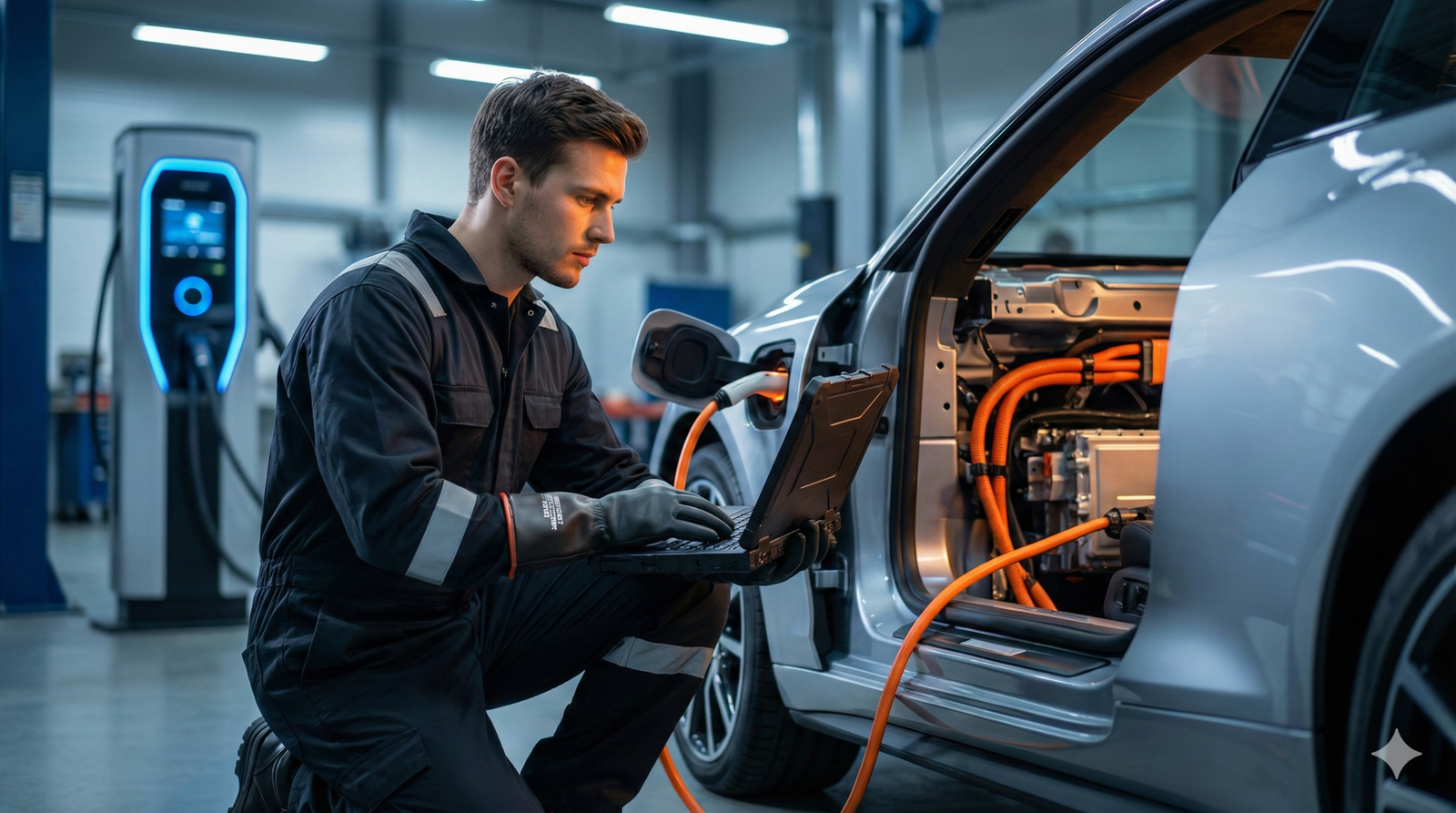
A younger technician walked up, plugged in a diagnostic laptop, ran a health check on the DC-DC converter, and realized a cooling fan was vibrating at a specific frequency. He adjusted the fan speed curve via software. Fixed in 10 minutes.
Jobs in EV maintenance are moving rapidly toward diagnostics. It’s less about physical strength and more about deductive reasoning.
A Surprising Tip for Freshers
Employers are desperate for people who understand CAN bus (Controller Area Network). This is the “language” the different parts of the car use to talk to each other. If you can look at a jumble of data on a screen and say, “The battery is fine, but the BMS isn’t telling the motor controller to accept power,” you are hired.
- The Mistake: Ignoring the “Check Engine” light logic because “EVs don’t have engines.” They have plenty of error codes.
- Actionable Step: Check out resources like the Electric Vehicle Service Lead Technician course by Skill India to understand the specific skills required. Buy a cheap OBD-II scanner and try to read codes on any car just to get used to the interface.
What Nobody Tells You: The “High Voltage” Safety Ticket
If you take only one thing away from this article, let it be this.
The biggest barrier to entry for jobs in EV maintenance is insurance and liability. Workshop owners are terrified that an untrained technician will touch an orange cable and get electrocuted.
If you walk into an interview with a certificate in <a href=”https://www.ase.com/ev/”>xEV High-Voltage Electrical Safety</a> (like the ones from ASE), you effectively skip the queue. It tells the employer, “You don’t have to worry about me dying on the job.”
It doesn’t matter if you are a mechanical or electrical diploma holder. Safety is the universal language of the EV shop floor.
How to Position Yourself (The Resume Hack)
When applying for these roles, stop using a generic CV.
Most diploma holders write: “Seeking a challenging position to utilize my skills.” Don’t do that.
Instead, write: “Diploma holder with focus on EV powertrain diagnostics and High Voltage safety protocols. Familiar with BMS logic and charging infrastructure maintenance.”
See the difference?
A Honest Word on Growth
These jobs are not easy. You will likely work shifts. You might be out in the sun fixing a charger on a highway, or in a warehouse dealing with dusty scooters.
But here is the trajectory:
- Year 1-2: Technician / Junior Engineer. You learn the systems inside out.
- Year 3-4: Team Lead / Diagnostic Expert. You stop turning wrenches and start solving complex system faults.
- Year 5+: Service Manager or Technical Trainer.
Because the industry is so new, if you have five years of hands-on experience in EV maintenance, you will be considered a “veteran.” You will be the one training the next generation.
Don’t wait for the perfect design job to fall into your lap. The charging stations are blinking red, the fleets are waiting, and the industry needs fixers. Go be one.
Editor — CareerEduTech Editorial Team Curated by senior faculty and industry alumni. We verify every guide against current industry standards to ensure accuracy and relevance for students. Disclaimer: Content is for educational purposes and not personalized financial or career advice.