The Shocking Reality of AP/TS POLYCET Counseling
“I got Rank 2,000 but got NO seat. My friend got Rank 12,000 and is studying in a Government Polytechnic. How is this possible?”
If you’ve heard this story (or worse, lived it), you’re not alone. Every year, thousands of students with excellent ranks walk away from POLYCET counseling empty-handed, while students with average ranks secure admission to good colleges.
The truth? The counseling computer is a robot. It doesn’t care about your rank, your hard work, or your potential. It follows your instructions (Web Options) with brutal precision. Give it bad instructions, and you’ll get a bad result—or no result at all.
This article reveals the 3 deadly mistakes students make during Web Options entry and shows you the exact “Safety Strategy” that winning students use.
Mistake #1: The “Top 10 Only” Trap (Overconfidence)
The Scenario
Meet Rajesh. He scored Rank 4,000—a fantastic achievement. He researched the previous year’s cutoffs and found that his dream colleges typically close around Rank 4,500. Confident in his rank, he entered only his Top 5 choices:
- Government Polytechnic, Masab Tank
- Government Polytechnic, Vijayawada
- Government Polytechnic, Kakinada
- Government Polytechnic, Warangal
- Government Polytechnic, Tirupati
Then he clicked “Freeze” and waited for results.
The Disaster
When seat allotment results came out, Rajesh saw: “No Seat Allotted.”
What happened? That year, the cutoff for these colleges closed at Rank 3,800 due to increased competition. The computer checked his Choice 1 (full), Choice 2 (full), Choice 3 (full), Choice 4 (full), Choice 5 (full)… and then stopped. Since he had no more options, he got nothing.
The Fix: The “Unlimited Options Rule”
Here’s the golden rule: Even if you’re Rank 1, enter 30-40 colleges minimum.
The Three-Tier Strategy:
- Top 10 colleges: Your dream institutions (even if they’re a stretch)
- Next 20 colleges: Realistic options based on your rank
- Next 10 colleges: Safety/backup colleges (where you’ll definitely get in)
Why does this work? Because the computer keeps checking until it finds an available seat. If your first 15 choices are full, it moves to choice 16, then 17, and eventually finds you a seat at choice 28. Without that 28th choice, you’d have nothing.
⚠️ WARNING: Being lazy costs seats. Entering 50 options takes 30 minutes. Spending a year without admission because you were too lazy to enter enough options? That’s a tragedy.
Mistake #2: Wrong Priority Order (The “Computer Logic” Fail)
How the Computer Actually Works
The counseling computer is ruthlessly efficient. It checks your Priority #1. If that seat is available, it allots it to you and immediately stops looking at your other choices.
This is where students make a fatal error.
The Blunder
Priya had Rank 6,000. She was nervous about not getting any seat, so she made this priority list:
- Small Private Polytechnic, Nellore (Easy to get in)
- Government Polytechnic, Vijayawada (Her dream college)
- Government Polytechnic, Guntur
- Government Polytechnic, Kurnool
Guess what she got? The small private polytechnic in Nellore.
Even though she had the rank for Vijayawada (cutoff was 7,500), the computer never checked Choice #2. Why? Because it found an available seat at Choice #1 and stopped.
The Iron Rule
Always order from BEST to WORST, not from EASY to HARD.
The computer doesn’t judge difficulty—it only follows your priority. Your #1 choice should be your absolute dream college, even if it’s a long shot. Put your “safe” colleges at the bottom (positions 25-40), not at the top.
Think of it this way: You’re giving the computer a shopping list. It buys the first available item and stops. Would you put “bread” at the top of your list when you really want “biryani”?
The “Freeze vs. Float” Confusion (CRITICAL SECTION)
This is where most students lose the game. The confusion between two different processes causes more seat losses than anything else.
Part 1: “Freezing” Your Web Options (BEFORE Allotment)
What “Freeze” means: Locking your priority list so it cannot be changed.
The Mistake: Clicking the “Freeze” button on Day 1 of the counseling period.
Why it’s dangerous: You might discover a better college option later, or realize you made a mistake in your priority order. Once you click “Freeze,” you cannot unlock it without physically visiting a Help Line Center (and sometimes not even then).
The Smart Move:
- Click “Save” every day as you research and add colleges
- Only click “Freeze” in the last hour before the deadline
- Keep your options flexible as long as possible
⚠️ WARNING: Do NOT click FREEZE until the final 1-2 hours of the deadline. Students who freeze early often regret it when they discover a better college or realize a mistake.
Part 2: The “Float” Strategy (AFTER Seat Allotment)
Important: In AP/TS POLYCET, there’s no button literally labeled “Float.” The equivalent concept is “Self-Reporting + Second Phase Counseling.”
The Scenario
You participated in Phase 1 counseling and got allotted your 5th choice college. You wanted your 1st choice, but it was full. Now Phase 2 counseling is coming up.
What do you do?
The Wrong Move (Disaster Path)
“I won’t report to the 5th choice college. I’ll just skip it and wait for Phase 2 counseling to get my 1st choice.”
Result: Your 5th choice seat is cancelled. You enter Phase 2 with NO backup. If you don’t get a seat in Phase 2 (which is highly competitive with fewer seats), you end up with NOTHING.
The Right Move (The “Float” Strategy)
- Accept the 5th choice seat online (Self-Report) to “safe keep” it
- Apply for Phase 2 counseling while keeping that seat
- Two possible outcomes:
- You get a better seat in Phase 2 → Your 5th choice is automatically cancelled, you move to the better college
- You don’t get a better seat in Phase 2 → You still have your 5th choice safe and secure
This is what “Floating” means: Keeping a backup seat while trying for an upgrade.
The Logic: Always secure what you have before reaching for something better. A seat in hand is worth two in the counseling portal.
The “Sliding” Myth
What students think Sliding is: “I’ll join Civil Engineering now and easily shift to Computer Science later.”
The Reality: Sliding (changing branches within the same college after admission) is extremely rare and depends on:
- Vacancies in the desired branch
- Your first-year marks
- College policy (many don’t allow it at all)
The Rule: Never join a branch you hate hoping to “slide” later. It’s gambling with your future. If you hate Civil Engineering, don’t take it hoping to switch to CSE. You’ll likely spend 3 years studying something you despise.
Your Web Options Checklist (Print This!)
Before you click “Freeze,” ensure you’ve done ALL of these:
✅ Entered MINIMUM 30-40 college options (more is better)
✅ Ordered from Dream → Realistic → Safety (not Easy → Hard)
✅ Double-checked every college code and branch code (one wrong digit = wrong college)
✅ Verified on Desktop/Laptop (not mobile phone where scrolling errors happen)
✅ Taken a screenshot of your final priority list
✅ Saved but NOT Frozen until the last 1-2 hours
✅ Understood the Self-Reporting process for Phase 2 eligibility
The Computer’s Logic (Visualized)
START
  ↓
Check Priority Choice #1
  ↓
Is seat available?
  ↓
YES → ALLOT SEAT → STOP (doesn't check other choices)
  ↓
NO → Check Priority Choice #2
  ↓
Is seat available?
  ↓
YES → ALLOT SEAT → STOP
  ↓
NO → Check Priority Choice #3
  ↓
(continues until seat found or list ends)
  ↓
NO MORE CHOICES → "No Seat Allotted"
This is why priority order matters! The computer stops at the first available seat.
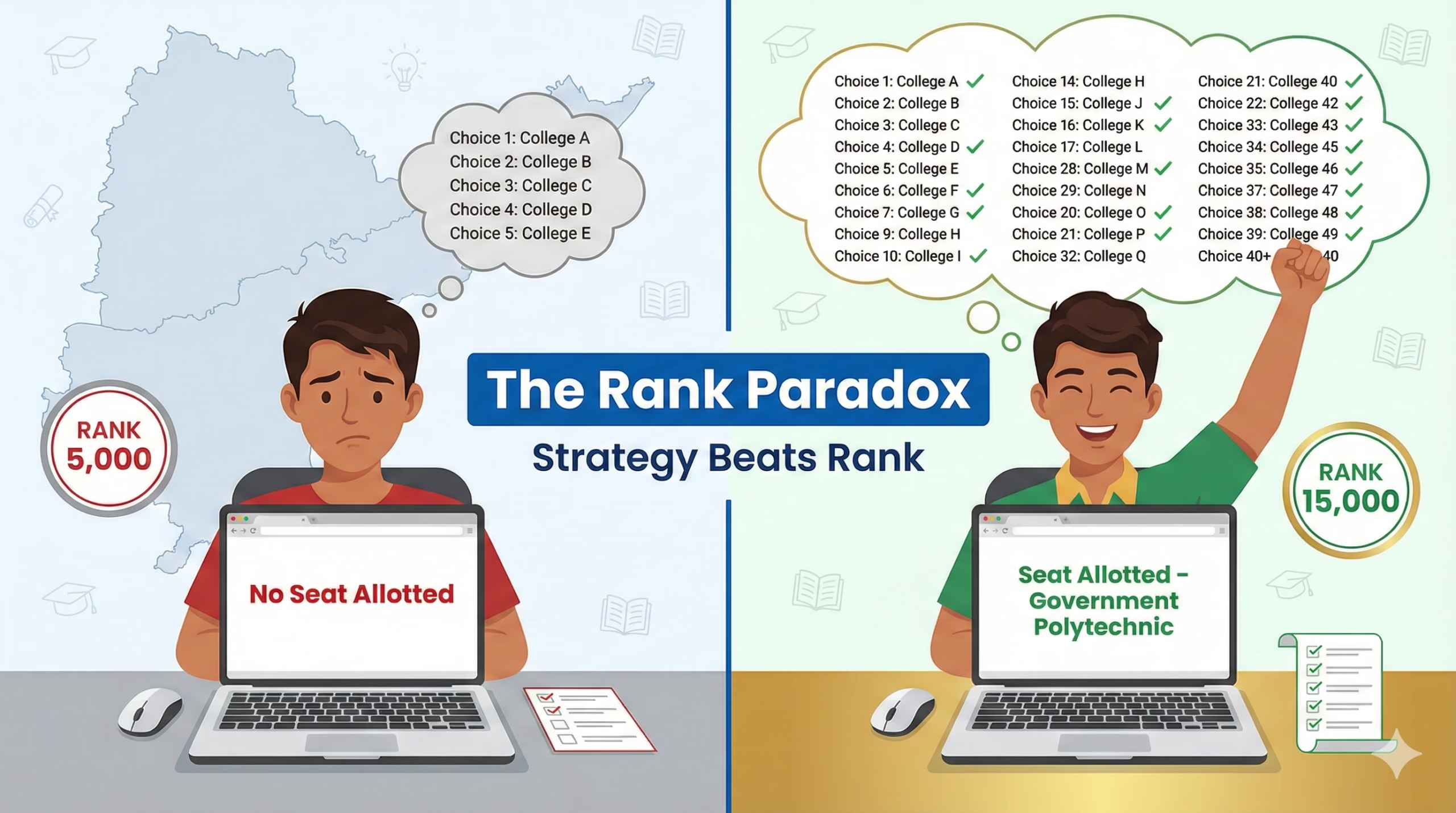
Why 15,000 Rank Beats 5,000 Rank
Now you understand the paradox:
Rank 5,000 student (Overconfident):
- Enters only 5 “Top” colleges
- All have cutoffs at Rank 4,800
- Gets: Nothing
Rank 15,000 student (Strategic):
- Enters 40 colleges (Top + Mid + Safety)
- Colleges 1-20 are full
- Gets: College #23 (a decent mid-tier polytechnic)
The Winner? The student who understood the system, not the student with the better rank.
Final Advice: Counseling is a Game of Chess, Not Luck
Your rank is just your entry ticket. What you do with the Web Options determines your college.
Three mindsets that kill good ranks:
- “My rank is good, so I don’t need many options” (Overconfidence)
- “I’ll put the easy college first to be safe” (Computer Logic Fail)
- “I’ll wait for Phase 2 without accepting Phase 1” (No Backup Plan)
The winning mindset:
- Maximum options (30-50 colleges)
- Smart priority (best to worst)
- Always keep a backup (Self-Report before Phase 2)
Your rank got you to the counseling table. Your strategy will get you the college. Don’t let poor planning waste months of hard work.
⚠️ MOBILE USERS WARNING: Do NOT enter Web Options on your mobile phone. Use a Desktop or Laptop to avoid scrolling errors, wrong clicks, and accidental submissions. Counseling centers often provide computer access if you don’t have one at home.
When do Web Options open? Typically in June after the POLYCET results. Check the official SBTET AP or TS Polycet website for exact dates. Start researching colleges NOW so you’re ready when the portal opens.
Remember: The computer doesn’t care about your story, your rank, or your dreams. It only cares about the instructions you give it. Make them count.
Good luck with your counseling! Study the system, plan strategically, and secure your future.