Written by a Technical Education Consultant with 10+ years of experience in counseling diploma aspirants across India’s Tier-2 and Tier-3 cities.
TL;DR: Key Takeaways
No Upper Age Limit: AICTE and most State Boards have removed the maximum age bar for admission; you can legally enter a polytechnic at 20, 30, or 40.
Scholarship Limits Exist: While admission is open, government fee reimbursement schemes (like JVD in AP or SVMCM in WB) often reject applicants over 20–25 years old.
The “Working Professional” Path: New 2024–27 rules allow employed individuals to pursue “Regular” diplomas with flexible timings if they work within a 50–75km radius of the college.
The New Rule: Is There an Upper Age Limit for Polytechnic?
The short answer is no; the All India Council for Technical Education (AICTE) has effectively dismantled age barriers to encourage lifelong learning.
Under the AICTE Approval Process Handbook (2024–27), regulatory caps on intake have been relaxed, and institutions are encouraged to facilitate “multiple entry and exit” points in line with NEP 2020. This shift means that technically, a student’s biological age is no longer a valid ground for denying admission to a diploma course.
However, “eligible for admission” does not always mean “eligible for jobs.” While colleges will welcome you at age 28, you must verify if your target employer (specifically government bodies like the Railways or CPWD) will hire a fresher of that age.

State-Wise Age Eligibility & Constraints (2025 Updates)
While the central mandate is open, every state enforces its own specific eligibility criteria through local admission tests.
Most states strictly enforce a minimum age (usually 14 or 15) to prevent child labor issues, but have removed the maximum age cap for entrance exams.
Uttar Pradesh (JEECUP)
For the 2025 session, candidates must be at least 14 years old as of July 1, 2025. There is explicitly no upper age limit for appearing in the JEECUP examination or seeking admission.3 This openness makes UP one of the most friendly states for older aspirants returning to education.
West Bengal (JEXPO)
Candidates must be at least 15 years old by July 1 of the admission year. Like UP, there is no upper age limit for the JEXPO entrance exam. However, admission to top government colleges often favors fresh Madhyamik pass-outs during tie-breaking in merit lists.
Maharashtra (Post-SSC Diploma)
Maharashtra follows a strict merit-based system with no upper age limit. The Directorate of Technical Education (DTE) allows students of any age to apply via the Centralized Admission Process (CAP), provided they have passed SSC with 35% marks.
Andhra Pradesh & Telangana (POLYCET)
Both states maintain no age limit for appearing in POLYCET.8 However, older candidates (above 20 for OC, 24 for Reserved categories) are generally ineligible for fee reimbursement schemes like Jagananna Vidya Deevena, meaning they must pay the full tuition fee out of pocket.
Quick Reference Table: State Age Rules vs. Financial Reality
| State | Exam | Min. Age | Max. Age (Admission) | Max. Age (Fee Waiver/Scholarship) |
| Uttar Pradesh | JEECUP | 14 Years | None | Flexible (Income-based) |
| West Bengal | JEXPO | 15 Years | None | Fresh pass-outs only (SVMCM) |
| Maharashtra | CAP | None | None | Generally < 25 preferred |
| Andhra Pradesh | AP POLYCET | None | None | 20 (OC), 24 (SC/ST/BC) |
| Telangana | TS POLYCET | None | None | 20–25 (varies by category) |
The “Working Professional” Quota: A New Path for Earners
If you are currently employed, you do not need to quit your job to get a diploma; you can utilize the AICTE’s “Working Professionals” provision.
Introduced in the 2024–25 cycle, this policy allows institutes to run specific batches for working employees. These are not distance or part-time courses; they are “Regular” diplomas with flexible timings (evenings/weekends).
Key Eligibility Rules:
Experience: You must have a minimum of one year of full-time work experience in a registered industry (Private/Public Ltd or MSME).
Proximity: Your workplace must be within a 50 km (in some updates extended to 75 km) radial distance from the institute. This ensures you can realistically attend classes.
Validity: Since these are certified as “Regular” courses, they are valid for government jobs that typically reject distance-learning diplomas.
The Financial Trap: Admission is Open, but Scholarships Aren’t
The biggest mistake older students make is assuming that because they can get in, they will get funded.
Most state scholarship portals (like UP Scholarship or MahaDBT) have algorithms that flag “Study Gaps.”
The Gap Penalty: If you passed Class 10 in 2018 and join a Polytechnic in 2025, you have a 7-year gap. While the college accepts you, the Social Welfare Department (SWD) may reject your scholarship application unless you provide a solid Gap Affidavit.
Merit Scholarships: High-value schemes like West Bengal’s SVMCM (₹1,500/month) are strictly for students who passed their qualifying exam in the current or immediately preceding year. An older student returning to study will likely be ineligible for this specific scheme.
Andhra/Telangana Reimbursement: As noted in the table above, the fee reimbursement age cap (20–24 years) is rigid. If you are 26, you can study, but you must pay the full fee.
Re-Entry Logistics: Gap Certificates and ABC IDs
Documentation is the primary hurdle for non-traditional students; you must prepare legal proofs to validate your break in education.
1. The Gap Certificate (Affidavit)
You cannot simply write a letter explaining your gap. You need a notarized affidavit on stamp paper (₹10–₹100 depending on the state).
What to declare: Clear dates of the gap and the reason (e.g., “Preparation for competitive exams,” “Financial constraints,” or “Employment”).
Crucial Clause: You must state, “I did not take admission in any other regular university course during this period.”
2. Academic Bank of Credits (ABC) ID
Under NEP 2020, every student needs an ABC ID. This is critical for older students because it allows for Multiple Entry and Exit. If you start a diploma now but have to leave for work after one year, your credits are stored in the ABC system (via DigiLocker) and remain valid for up to 7 years, allowing you to return later without restarting.
The Career Ceiling: When is “Too Late” for a Diploma?
You should calculate your “Graduation Age” against the recruitment age limits of your target jobs.
A diploma is an investment. If your goal is a government job (Junior Engineer), you must graduate before you hit the age ceiling for these exams.
SSC Junior Engineer (Central Govt): The general age limit is 30 or 32 years depending on the department (CPWD allows 32).22 If you are General category and start a 3-year diploma at 29, you will graduate at 32, leaving you with zero attempts for most posts.
RRB Junior Engineer (Railways): The standard limit is 18–33 years. (Note: A one-time relaxation to 36 years was granted for the 2024–25 cycle due to Covid, but you cannot bank on this for future cycles).
State JE Exams: This is the safest bet for older candidates. States like Uttar Pradesh (UPSSSC) and Rajasthan (RSMSSB) often have age limits up to 40 years, offering a viable career path even for those graduating in their mid-30s.
FAQ: Common Doubts for Late Starters
Q: I am 26 years old. Can I do a regular Polytechnic Diploma?
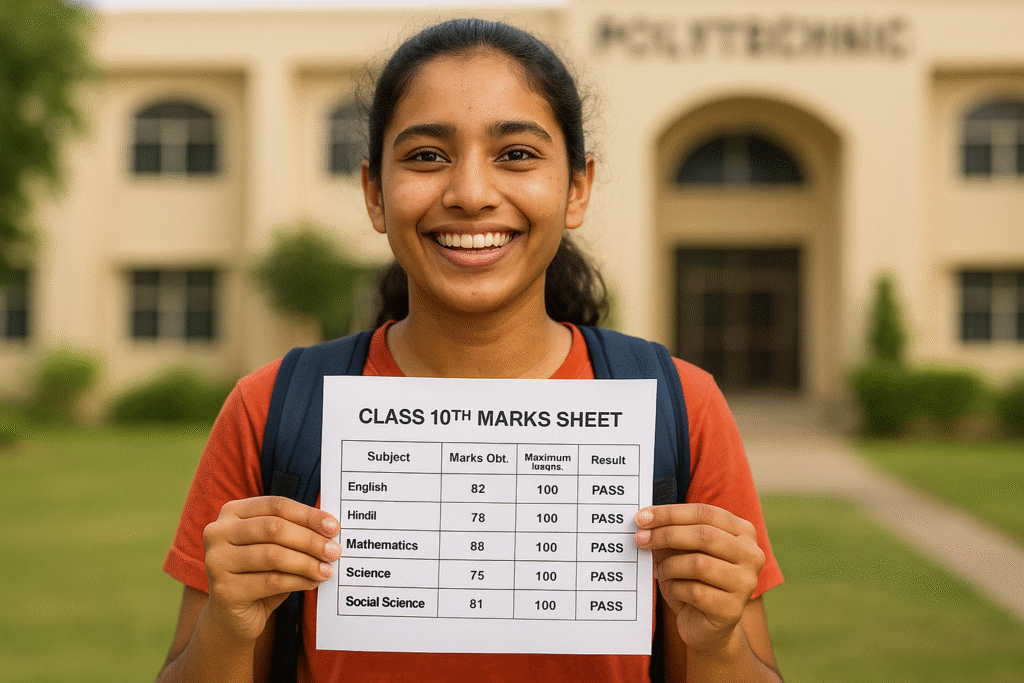
A: Yes. There is no legal upper age limit for admission in most states (UP, Maharashtra, WB, etc.). You will compete in the general merit list based on your Class 10 marks.
Q: Will a “Working Professional” diploma be valid for Govt Jobs?
A: Yes, provided the course is AICTE-approved as a “Regular” course with flexible timings. Avoid “Distance Learning” diplomas for engineering roles, as they are often rejected by RRB and SSC.
Q: Can I get a scholarship with a 5-year gap after 10th?
A: It is difficult but possible in states like UP, provided you submit a valid Gap Affidavit and your family income is below the threshold. However, merit-based schemes like SVMCM (WB) will likely reject the application.
Q: I have an ITI certificate. How does age affect Lateral Entry?
A: Lateral entry allows you to join directly in the 2nd year. Most states have no upper age limit for this either. It saves you one year, which is crucial for staying under the recruitment age limits.
Conclusion: Define Your End Goal
The doors to Indian polytechnics are wider open in 2025 than ever before. The “No Age Limit” policy is a massive win for those seeking a second chance at education. However, you must be strategic.
If you are under 25, aim for central government jobs (SSC/RRB) and apply for scholarships aggressively with proper gap documentation.
If you are over 28, focus your energy on State Government jobs (which allow up to 40 years) or private sector upskilling. Do not rely on government fee reimbursement; plan your finances to self-fund your diploma.
Disclaimer: Rules regarding age relaxation, fee reimbursement, and recruitment limits are subject to annual notifications by AICTE and State Governments. Always verify with the latest information brochure for your specific state.



Comments are closed.