
“Hard work covers the syllabus; smart work covers the marks.”
With POLYCET 2026 approaching, you cannot afford to revise all 14 chapters of Science with equal intensity. The key to cracking this exam lies in understanding where the maximum marks come from—and directing your energy there. Here’s a critical insight most students miss: AP POLYCET gives Physics 40 marks (higher weightage), while Chemistry gets 30 marks. In TS POLYCET, both Physics and Chemistry carry equal weight at 30 marks each. This means for AP students, Physics is your rank decider. Based on analysis of the last 5 years of question papers (2020–2025), this article reveals the exact chapters that contribute to nearly 50-60% of your Science score.
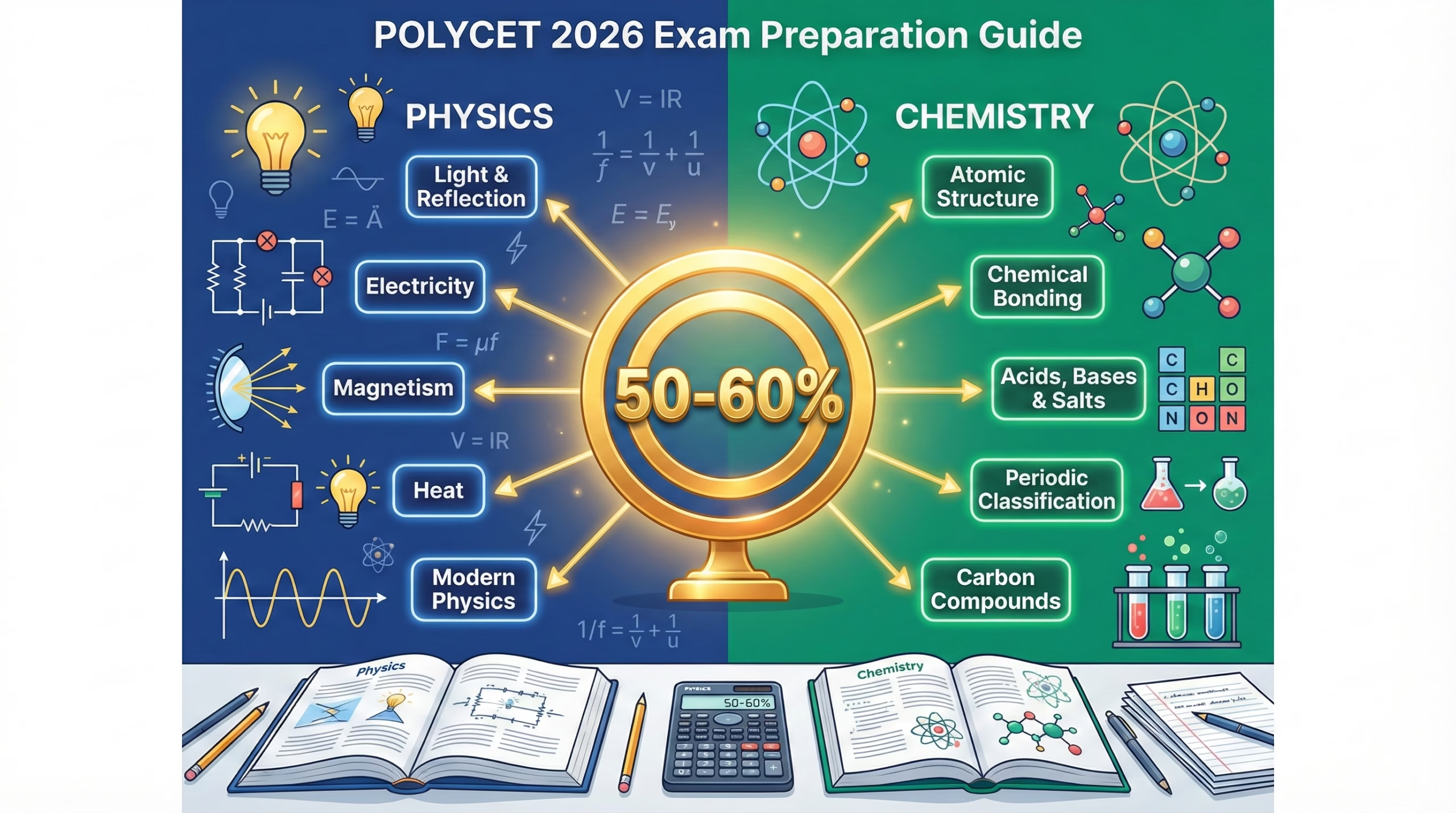
Physics: The “Rank Decider” (Top 5 Chapters)
These chapters are listed in order of priority, with special emphasis on AP weightage where it’s significantly higher.
1. Electric Current (The Kingmaker)
Why it matters: Electric Current consistently carries the highest weightage in Physics, especially in AP POLYCET. This single chapter can make or break your rank.
Key Topics to Master:
- Ohm’s Law (V=IRV = IR ) – Direct formula-based questions
- Series vs. Parallel Circuits – Numerical problems on equivalent resistance
- Electric Power (P=VIP = VI ) and Energy (E=PtE = Pt )
- Heating effect of current and practical applications
Estimated Marks: 6-8 Marks (AP) | 5-6 Marks (TS)
Strategy Tip: Practice at least 20 numerical problems on circuit calculations. Examiners love testing your ability to apply series/parallel formulas in combination.
2. Electromagnetism
Why it matters: Often paired with Electric Current in the question paper. The conceptual nature of this chapter makes it a favorite for setting multiple-choice questions.
Key Topics to Master:
- Fleming’s Left Hand Rule (Motor effect) vs. Fleming’s Right Hand Rule (Generator effect)
- Magnetic field lines and their properties
- Principle of Electric Motor and Electric Generator
- Electromagnetic induction basics
Estimated Marks: 5-6 Marks
Strategy Tip: Create a comparison chart for Motor vs. Generator. Questions often test whether you can distinguish between the two principles.
3. Reflection of Light (Curved Surfaces)
Why it matters: The foundation of the entire Optics unit. This chapter has predictable question patterns—master the formulas and you’re guaranteed marks.
Key Topics to Master:
- Mirror Formula: 1f=1v+1u\frac{1}{f} = \frac{1}{v} + \frac{1}{u}
- Magnification: m=h′h=−vum = \frac{h’}{h} = \frac{-v}{u}
- Ray diagrams for concave and convex mirrors
- Position, nature, and size of images for different object positions
- Sign conventions (crucial for avoiding silly mistakes)
Estimated Marks: 4-5 Marks
Strategy Tip: Don’t just memorize the formula—understand the sign convention. Many students lose marks by getting the signs wrong in numerical problems.
4. Refraction of Light (Lenses)
Why it matters: Lenses confuse students more than mirrors, which is exactly why examiners set “tricky” questions here. High difficulty = high scoring opportunity for prepared students.
Key Topics to Master:
- Lens Formula: 1f=1v−1u\frac{1}{f} = \frac{1}{v} – \frac{1}{u}
- Power of Lens (measured in Diopters): P=1fP = \frac{1}{f} (where ff is in meters)
- Refractive Index: n=cvn = \frac{c}{v} (speed of light in vacuum / speed in medium)
- Convex vs. Concave lens behavior
- Total Internal Reflection (basic concept)
Estimated Marks: 4-5 Marks
Strategy Tip: The difference between the mirror formula and lens formula is subtle but critical. Practice identifying which formula to use in mixed questions.
5. Heat (The Hidden Gem)
Why it matters: High ROI (Return on Investment). This is a relatively small chapter but consistently yields 4-5 marks because it’s formula-heavy and examiners can set quick numerical questions.
Key Topics to Master:
- Specific Heat Capacity: Q=msΔTQ = ms\Delta T
- Method of Mixtures (calorimetry problems)
- Latent Heat of Fusion and Vaporization
- Evaporation vs. Boiling (conceptual difference)
- Temperature conversion (Celsius to Kelvin)
Estimated Marks: 4-5 Marks
Strategy Tip: Memorize specific heat values of common substances (water, aluminum, copper). Questions often provide these, but knowing them saves time.
Chemistry: The “Score Booster” (Top 5 Chapters)
Chemistry is generally easier to score full marks in if your concepts are crystal clear. These five chapters form the conceptual backbone of the POLYCET Chemistry syllabus.
1. Chemical Bonding
Why it matters: The most fundamental chapter in Chemistry. Questions are direct, formula-based, or logic-based—perfect for guaranteed marks.
Key Topics to Master:
- Ionic vs. Covalent bond properties (melting point, conductivity, solubility)
- VSEPR Theory: Bond angles (109°28′109°28′ for tetrahedral, 120°120° for trigonal planar, 180°180° for linear)
- Hybridization (sp, sp², sp³)
- Electronegativity and bond polarity
- Lewis dot structures
Estimated Marks: 5-6 Marks
Strategy Tip: Create a properties table for ionic vs. covalent compounds. At least 2-3 questions will directly test this comparison.
2. Structure of Atom
Why it matters: This chapter has fixed formulas and well-defined concepts. If you understand the quantum number rules, you can solve any question in under 30 seconds.
Key Topics to Master:
- Quantum Numbers: Principal (nn ), Azimuthal (ll ), Magnetic (mm ), Spin (ss )
- Rules: l=0l = 0 to (n−1)(n-1) , m=−lm = -l to +l+l , s=±12s = ±\frac{1}{2}
- Electronic Configuration using Moeller Diagram (Aufbau principle)
- Bohr’s Model: En=−13.6n2E_n = -\frac{13.6}{n^2} eV
- Hund’s Rule and Pauli Exclusion Principle
Estimated Marks: 4-5 Marks
Strategy Tip: Draw the Moeller Diagram once before the exam starts. Use it as a reference for electronic configuration questions.
3. Acids, Bases, and Salts
Why it matters: This is practical chemistry—concepts you can relate to everyday life. Easy to memorize, easy to score.
Key Topics to Master:
- pH value problems (pH < 7 = acidic, pH = 7 = neutral, pH > 7 = basic)
- Water of Crystallization formulas:
- Plaster of Paris: CaSO4⋅12H2O\text{CaSO}_4 · \frac{1}{2}\text{H}_2\text{O}
- Gypsum: CaSO4⋅2H2O\text{CaSO}_4 · 2\text{H}_2\text{O}
- Common indicators (Litmus, Phenolphthalein, Methyl Orange)
- Salt hydrolysis and nature of salts
- Neutralization reactions
Estimated Marks: 4-5 Marks
Strategy Tip: Memorize the pH range and color changes for all three major indicators. This is a guaranteed 1-2 mark question.
4. Carbon and its Compounds
Why it matters: The largest chapter in Chemistry, but also the most scoring if you focus on the high-frequency topics.
Key Topics to Master:
- IUPAC Naming of organic compounds (alkanes, alkenes, alkynes)
- Allotropes of Carbon (Diamond, Graphite, Fullerene C₆₀)
- Functional groups (alcohol, aldehyde, ketone, carboxylic acid)
- Cleaning action of soap: Formation of micelles
- Combustion and oxidation reactions
- Homologous series concept
Estimated Marks: 4-5 Marks
Strategy Tip: Focus on structural formulas and functional group identification. These are quicker to solve than IUPAC naming questions.
5. Classification of Elements (Periodic Table)
Why it matters: Trend-based questions are almost guaranteed every year. If you understand the “why” behind the trends, you can deduce answers even for elements you haven’t studied.
Key Topics to Master:
- Trends in Atomic Radius: Decreases left to right (across period), Increases top to bottom (down group)
- Trends in Ionization Energy: Increases left to right, Decreases top to bottom
- Trends in Electronegativity: Increases left to right, Decreases top to bottom
- Metallic vs. Non-metallic character
- Valency determination from group number
- Mendeleev’s vs. Modern Periodic Law
Estimated Marks: 3-4 Marks
Strategy Tip: Draw arrows on a blank periodic table showing trend directions. Visual memory works better than memorizing rules.
The “Cheat Sheet” Table (Quick Revision)
| Subject | Chapter | Priority Level | Avg. Marks (AP/TS) |
|---|---|---|---|
| Physics | Electric Current | High | 6-8 / 5-6 |
| Physics | Electromagnetism | High | 5-6 / 5-6 |
| Physics | Reflection of Light | High | 4-5 / 4-5 |
| Physics | Refraction of Light | High | 4-5 / 4-5 |
| Physics | Heat | Medium-High | 4-5 / 4-5 |
| Chemistry | Chemical Bonding | High | 5-6 / 5-6 |
| Chemistry | Structure of Atom | High | 4-5 / 4-5 |
| Chemistry | Acids, Bases, Salts | High | 4-5 / 4-5 |
| Chemistry | Carbon Compounds | High | 4-5 / 4-5 |
| Chemistry | Periodic Table | Medium-High | 3-4 / 3-4 |
Screenshot this table for last-minute revision!
3 Common Blunders to Avoid
1. Ignoring Units in Physics
Many students calculate the correct numerical answer but choose the wrong option because they don’t check units. For example, if you calculate focal length as 10 but don’t notice the answer should be in meters (not centimeters), you’ll pick 10 cm10\text{ cm} instead of 0.1 m0.1\text{ m} or 10 m10\text{ m} .
Fix: Always write the unit alongside your calculation. If the question asks for the answer in a specific unit, convert before looking at options.
2. Confusing Periodic Trends (Group vs. Period)
Students often mix up:
- “Across a period” (left to right) trends with
- “Down a group” (top to bottom) trends
For example, atomic radius increases down a group but decreases across a period. Swapping these will guarantee wrong answers.
Fix: Create a mnemonic. “Period = Power increases” (Ionization Energy, Electronegativity increase across period).
3. Skipping Numericals (The Myth of “Theory-Based” POLYCET)
Many students think POLYCET is “theory-heavy” and neglect numerical problem practice. This is false. Physics has approximately 40% numerical questions, especially from Electric Current, Heat, and Optics.
Fix: Solve at least 10 numerical problems from each high-weightage chapter. Time yourself—you should solve one numerical in under 1 minute during the exam.
Final Word: The “Rule of 50%”
In both AP and TS POLYCET, just 5 chapters in Physics and 5 chapters in Chemistry contribute to nearly 50-60% of your total Science score. This means:
✅ Master these 10 chapters → Secure 35-40 marks out of 70 (Science)
✅ Add moderate preparation for the remaining chapters → Push your score to 55-60 marks
✅ Result: A rank that gets you into your dream polytechnic
Remember: Smart work isn’t about working less—it’s about working strategically. Now that you know what to study, the next step is planning how to study it. Allocate more time to Electric Current and Chemical Bonding, moderate time to Heat and Periodic Table, and you’ll maximize your marks per hour of study.
Disclaimer:
Weightage varies slightly by 1-2 marks every year depending on the question paper setter. However, the chapters listed above have maintained consistent high weightage over the last 5 years (2020-2025) and are expected to remain crucial for 2026.