AICTE mandates a near-total refund of the tuition fee, minus a processing charge of ₹1,000, provided you withdraw before the session starts.
In my experience, colleges rarely volunteer this information. For the 2025-26 academic cycle, the All India Council for Technical Education (AICTE) has reinforced that any student withdrawing before the cutoff must receive their money back promptly. This rule applies to all technical diplomas, including Engineering, Pharmacy, and Architecture.
If you have already started attending classes, the refund becomes “proportionate.” The college will deduct the monthly fee and hostel charges for the time you stayed and refund the rest. This ensures you aren’t paying for an entire year when you only spent a week on campus.
Difference Between Government and Private Polytechnic Refunds
While government polytechnics follow rigid treasury-led processes, private institutions are governed by AICTE mandates but often require more aggressive follow-ups from the student’s end.
Government polytechnic refunds are generally safer but slower because the money has to move through state treasury departments. I have seen these take 3 to 6 months to hit a student’s bank account. You will likely need to submit a formal application to the Principal and wait for the Directorate of Technical Education (DTE) to clear it.
Private polytechnics, on the other hand, have the funds on-site but may try to “stall” you. They might claim their “internal policy” doesn’t allow refunds, but this is a bluff. Federal guidelines from AICTE and UGC override any private college’s internal rules, no matter what you signed during admission.
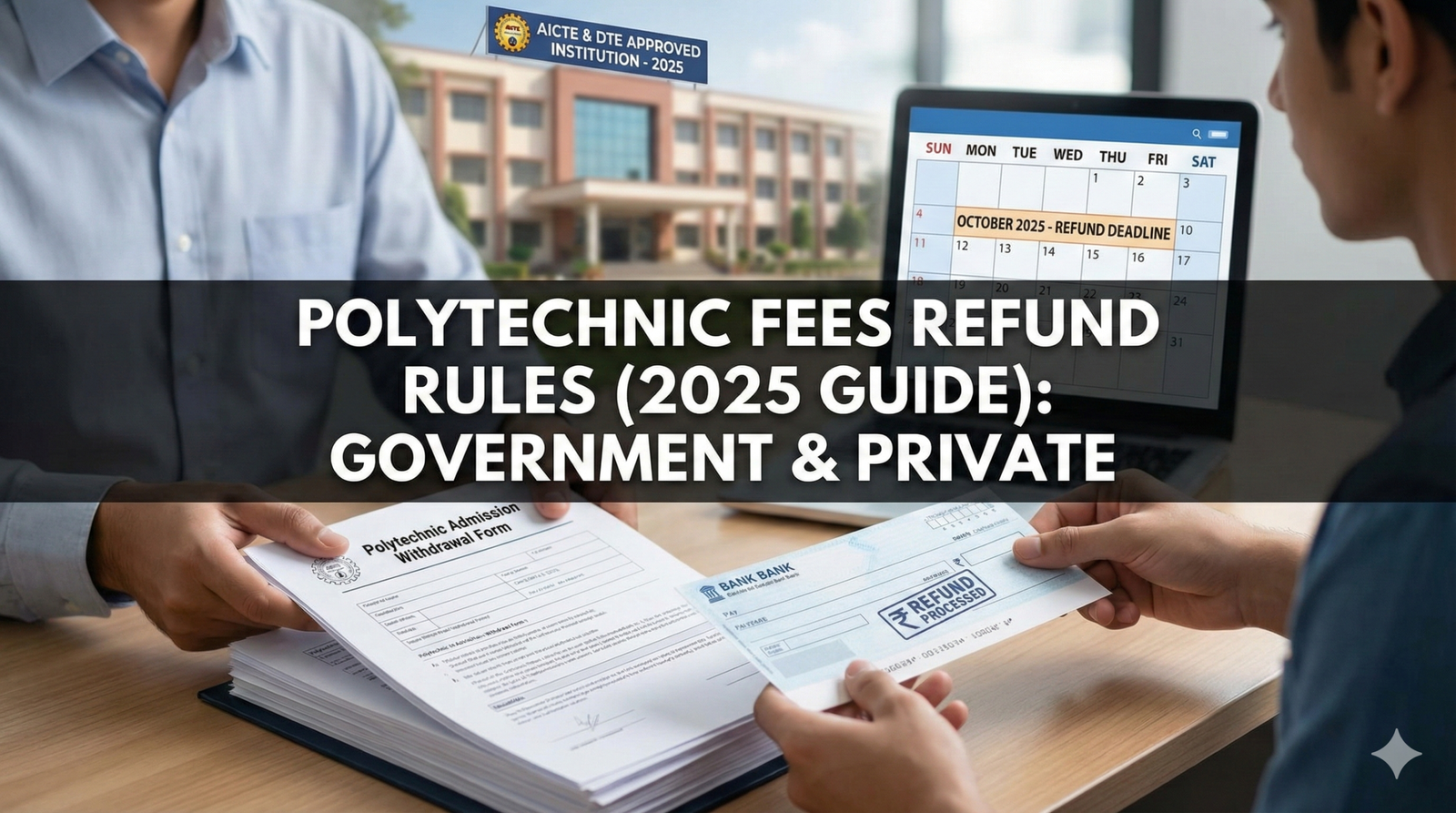
The Withdrawal Timeline: How Much Money Will You Lose?
Your refund amount is determined by a tiered percentage system that drops significantly once the “Last Date of Admission” has passed.
The timing of your written application is the only thing that matters in the eyes of the law. I always tell my students to send their withdrawal via registered email and a physical letter with a “received” stamp. This creates a paper trail that the college cannot ignore.
| Time of Withdrawal Notice | Refund Percentage | Maximum Deduction Allowed |
| 15 days or more before the deadline | 100% | ₹1,000 |
| Less than 15 days before the deadline | 90% | 10% of total fee |
| 15 days or less after the deadline | 80% | 20% of total fee |
| 30 days or less after the deadline | 50% | 50% of total fee |
| More than 30 days after the deadline | 0% | Full Fee |
The Unique Perspective: The “Ghost Seat” Leverage
I’ve found that most students give up on their refund if they miss the 30-day window. However, there is a “Counter-Intuitive Insight” you won’t find on most blogs: the Vacancy Clause.
If you leave mid-semester and the college admits another student to your seat (often through a spot round or lateral entry), they must refund your fee. They are legally prohibited from collecting double fees for the same seat. If you suspect your seat was filled, you can demand proof of the current vacancy status under the Right to Information (RTI) act.
Case Study: The Mid-September Recovery
Last year, I assisted a student who withdrew from a private Mechanical Diploma in mid-September—well past the “zero refund” 30-day mark. The college initially refused any refund, citing their internal “no-refund” policy.
We checked the updated merit list and found that a lateral entry student had taken his roll number. By citing the AICTE Approval Process Handbook Clause 6.45, we forced the college to refund 90% of his tuition. The college realized that “double-dipping” on fees would lead to a heavy fine from the Council, and they paid up within a week.
Can a Private College Refuse to Return My Original Documents?
No, it is strictly illegal under AICTE/UGC guidelines for any institution to retain a student’s original mark sheets or certificates as leverage for fees.
I have seen colleges try to keep 10th-grade mark sheets “hostage” until the student pays the full three-year fee. This is a direct violation of federal law. Colleges are only allowed to keep a set of photocopies; they must return the originals immediately upon withdrawal.
If a college threatens to keep your documents, do not argue with the clerk. Simply hand them a copy of the latest AICTE public notice on “Non-Retention of Original Certificates.” Mentioning a formal complaint to the “AICTE Grievance Redressal Cell” usually resolves the issue instantly.
Frequently Asked Questions
1. What if the college delays the refund beyond 7 days?
You should immediately file a complaint on the AICTE Centralized Support and Monitoring System (CSMS). Institutions found delaying refunds can face “reduction in intake” or even “withdrawal of approval.”
2. Is the “Counseling Fee” or “Prospectus Fee” refundable?
Usually, no. Small administrative fees (typically under ₹1,000-₹2,000) for the application or prospectus are generally considered non-refundable as they cover processing costs.
3. Can I get a refund if I’m joining another course in the same college?
Yes, most colleges will simply “adjust” the fee to the new course. However, you should still get a fresh receipt to ensure the timeline for the new course’s refund policy is reset.
4. Does this apply to “Management Quota” seats?
Yes. Even if you took a management seat, the college is still an AICTE-approved institution. They must follow the national refund grid regardless of how you secured the seat.
Would you like me to draft a formal “Admission Withdrawal and Refund Request” letter template you can send to your college?