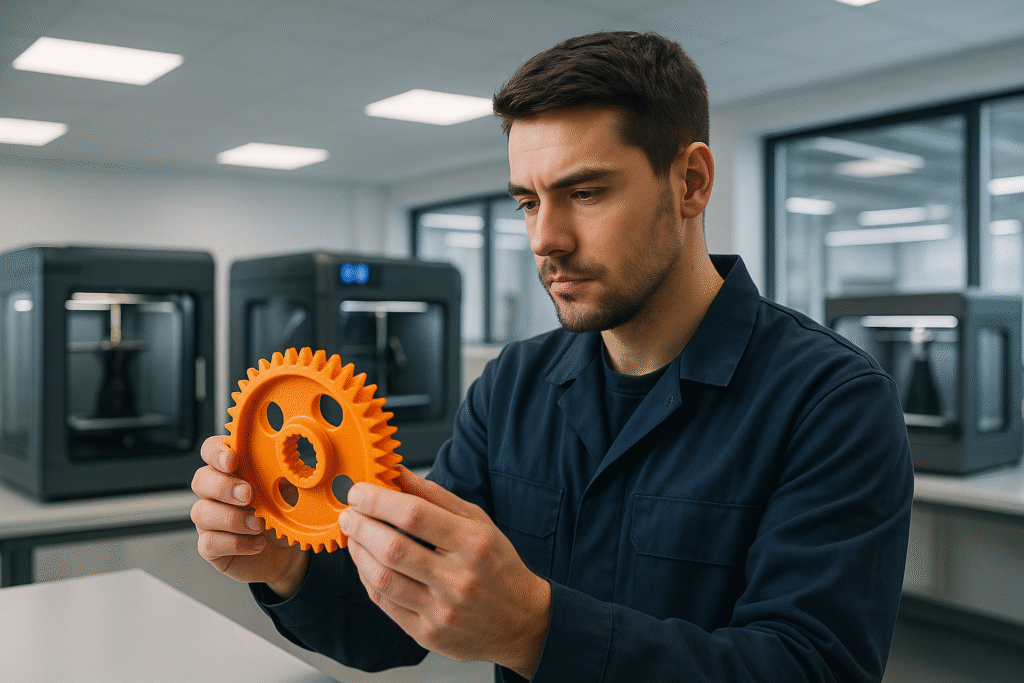
Last week, a final-year Mechanical student named Rahul walked into my office. He looked pale. “Sir,” he said, “I saw a video of a robot doing welding in a Tesla factory. If a machine can weld better than me, why am I even doing this Diploma? Will I even have a job at Mahindra or L&T by 2026?”
I have seen thousands of students like Rahul over my 20 years in this institute. From the era of manual drawing boards to the rise of CAD/CAM, the fear is always the same. But here is the hard truth: AI isn’t coming for your job; it’s coming for the boring, repetitive, and dangerous parts of your job. If you remain a “traditional” technician who only knows how to turn a wrench, you are at risk. But if you become an AI-Augmented Technician, your value will triple.
🚀 Key Takeaways for the Busy Student
- The Shift: Industry 4.0 is moving from “Manual Fixing” to “Predictive Monitoring.”
- The Survival Kit: IoT, Data Literacy, Soft Skills, PLC/SCADA, and Hybrid Learning.
- The Money: Technicians with AI-related certifications earn 30-50% higher starting salaries (₹3.5 LPA vs ₹2.2 LPA).
- Action Point: Start one NPTEL or Swayam course on “Smart Manufacturing” this semester.
💡 Quick Answer: The “Too Long; Didn’t Read” Summary
AI will replace technicians who only follow instructions. It will empower technicians who can troubleshoot the AI. Companies like Tata Motors and Reliance Industries are looking for “Smart Technicians” who can manage the sensors, interpret the data, and bridge the gap between software and heavy machinery.

1. IoT and Sensor Integration: Being the “Eyes” of the Machine
In the old days, if a pump failed at a Tata Power plant, you waited for it to make a noise or leak smoke. Today, that pump has sensors measuring vibration, temperature, and flow rate.
AI needs data to work. That data comes from sensors. If you are a Civil, Electrical, or Mechanical Diploma holder, you must understand how these sensors work.
What you need to do:
- Learn the basics of Arduino or Raspberry Pi. You don’t need to be a coder, but you should know how to wire a sensor to a controller.
- Understand protocols like MQTT or Modbus. These are the “languages” machines use to talk.
- Practical Step: Download a free sensor-simulator app on your phone. See how your phone’s accelerometer data changes when you move it. That is exactly how an industrial vibration sensor works.
2. Predictive Maintenance (PdM): Moving Beyond the Wrench
I remember a student who worked at a sugar mill near Meerut. They used to change the oil every 30 days regardless of the machine’s health. That is a waste of money (₹).
With AI, we use Predictive Maintenance. The AI tells us, “Based on the heat profile, this bearing will fail in 48 hours.” Your job as a technician isn’t just to fix the broken bearing, but to validate the AI’s prediction.
What you need to do:
- Study the physics of failure. Learn how heat and friction affect components.
- Learn to read “Dashboards.” Instead of looking at a physical pressure gauge, you will be looking at a tablet.
- Practical Step: Research “Vibration Analysis” basics. It is the most common way AI predicts mechanical failure.
3. Human-Centric “Soft” Skills: The AI Can’t Lead a Crew
I always tell my students: “A robot can weld a joint, but it cannot explain to a frustrated site supervisor why the shipment is delayed.”
In Indian industries, we deal with a diverse workforce—from unskilled laborers to senior managers. AI lacks Emotional Intelligence. It cannot negotiate, it cannot motivate a team under a 45°C sun on a construction site, and it cannot handle “Jugaad” when a specific spare part isn’t available.
What you need to do:
- Improve your Technical English and local language communication. You are the bridge between the “Cloud” and the “Ground.”
- Learn basic Project Management. Use tools like Google Sheets or Trello to track tasks.
- Practical Step: Volunteer to lead your final year project team. Handle the conflicts, the budget, and the timeline. That is “Management,” and AI can’t touch it.
4. Basic Data Literacy: Understanding the “Why”
You don’t need to be a Data Scientist, but you must not be “Data Blind.” If an AI system shows a graph where the power consumption of a motor is $P = VI \cos \phi$ and the power factor is dropping, you should know that the motor is under too much load or the capacitors are failing.
What you need to do:
- Brush up on your basic Engineering Mathematics. Understand averages, trends, and percentages.
- Learn basic Excel. If you can create a pivot table, you are already ahead of 70% of Diploma holders in India.
- Practical Step: Look at your own electricity bill for the last 6 months. Plot it in Excel. Can you see a trend? That is data literacy.
5. PLC, SCADA, and Automation Programming
For my Electrical and Electronics students, this is your bread and butter. The “Brain” of the factory is the PLC (Programmable Logic Controller). AI is being integrated into these PLCs to make them “Self-Learning.”
Companies like Siemens, ABB, and Schneider Electric are desperate for Diploma Engineers who can troubleshoot PLC code on the fly.
What you need to do:
- Learn Ladder Logic programming. It is visual and much easier than C++ or Java.
- Get familiar with HMI (Human Machine Interface) design.
- Practical Step: Many websites offer free PLC simulators. Spend 30 minutes a day “wiring” virtual circuits.
📊 The Evolution of the Technician: A Comparison
| Feature | Traditional Technician (Old School) | AI-Augmented Technician (The Future) |
|---|---|---|
| Primary Tool | Spanner, Multimeter, Hammer | Tablet, IoT Sensors, Diagnostic Software |
| Maintenance Style | Reactive (Fix when it breaks) | Predictive (Fix before it breaks) |
| Data Usage | Manual Logbooks (Paper) | Real-time Cloud Dashboards |
| Entry Salary (Avg) | ₹15,000 – ₹18,000 / month | ₹25,000 – ₹35,000 / month |
| Top Employers | Small Workshops, Local Contractors | Reliance, Adani, Maruti Suzuki, L&T |
❓ Frequently Asked Questions (FAQs)
Q1: Do I need to learn Python or complex coding to survive?
No. You don’t need to write the AI algorithms. You just need to know how to interact with them. Think of it like a car: you don’t need to be an engine designer to be a world-class Formula 1 driver, but you must understand how the engine responds.
Q2: Will the JE (Junior Engineer) exams like SSC-JE or RRB-JE change because of AI?
The core syllabus (Strength of Materials, Thermodynamics, Circuit Theory) will remain the same for now. However, “General Awareness” and “Technical Interviews” are already shifting. Expect questions on Industry 4.0 and Automation in your personal interviews.
Q3: I am from a rural background and my college doesn’t have high-tech labs. How can I learn?
The internet is the great equalizer. Use Swayam (NPTEL)—it’s an initiative by the Govt. of India. The courses are free, and if you pay a small fee for the exam, you get a certificate from an IIT. That certificate on your resume carries massive weight at companies like Mahindra.
🎯 Final Words of Advice
I’ve been in this field for two decades. I saw the fear when computers first arrived in our labs. People said, “The Accountant is dead.” Instead, the Accountant got a better tool (Excel) and became more productive.
The same is happening to you. AI is just a high-tech “Spanner.” Don’t fear the tool—master it. The Indian industry is growing at a massive rate. With the Gati Shakti and Make in India initiatives, we need millions of technicians. But we don’t need “Old School” technicians; we need the ones who can speak the language of machines and data.
Pick one skill from this list today. Not tomorrow. Today. Go to YouTube, search for “Basic PLC Ladder Logic” or “Introduction to IoT,” and start your journey. Your future self—and your future paycheck—will thank you.
Stay curious. Stay technical. The future belongs to those who aren’t afraid to unlearn and relearn.