Written by a Technical Education Consultant with 10+ years of experience in Indian Diploma Counseling and curriculum compliance analysis.
TL;DR: Key Takeaways
The “90-Day” Reality: Semesters are compressed into 15 weeks of instruction; missing even one week of lab sessions can lead to “Detention” (barred from exams).
No Aggregation: You must pass Theory, Practical, and Internal assessments separately. High written marks cannot save you if you fail the internal sessional.
New Credit Rules (2025): Under NEP 2020, your “Pass” status is now stored as credits in the Academic Bank of Credits (ABC), allowing you to exit and rejoin the course later.
1. How the Polytechnic Semester System Actually Works
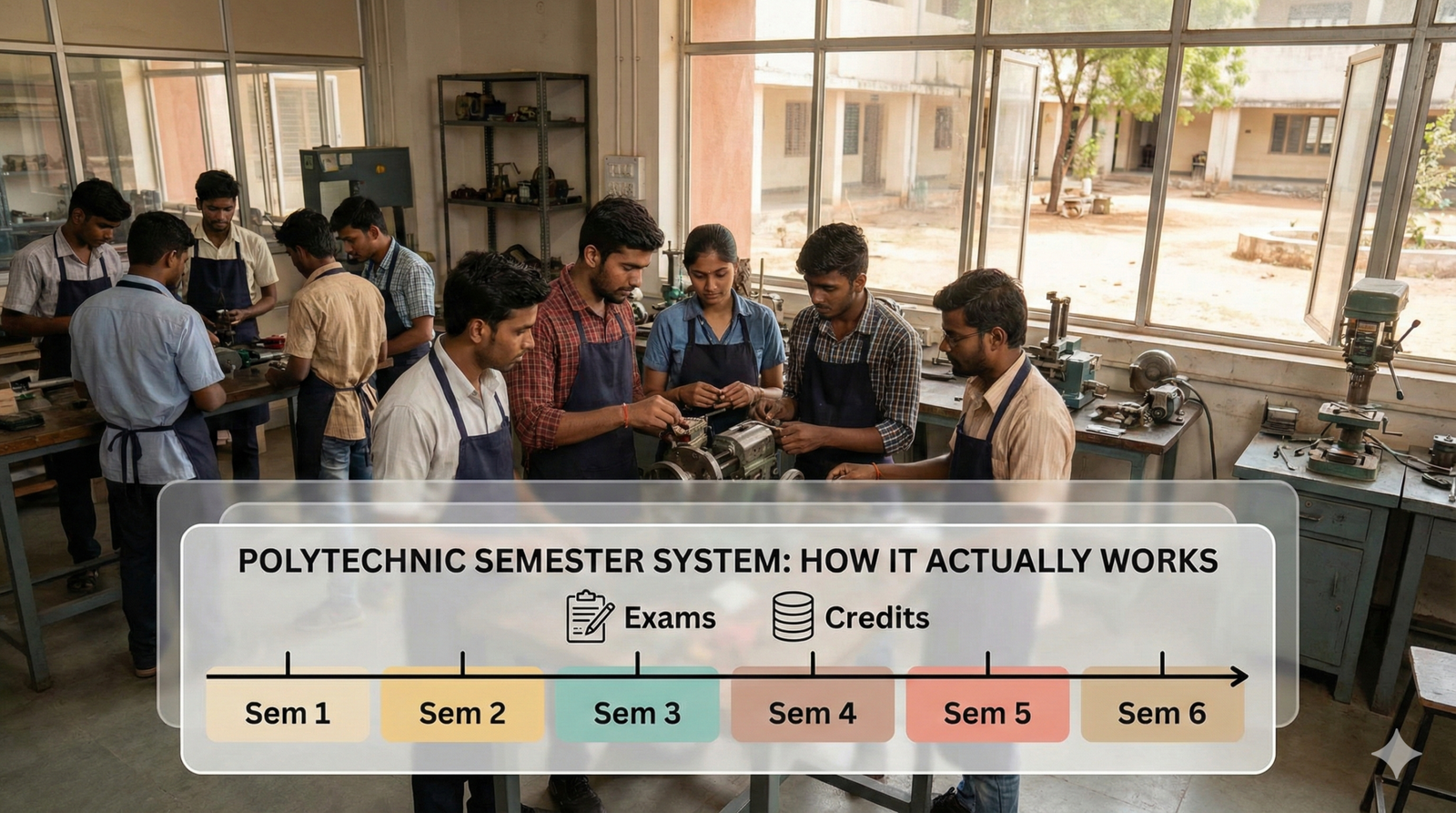
The Indian polytechnic semester system divides the academic year into two rigorous 90-day cycles, demanding consistent attendance and continuous assessment. Unlike the annual pattern, this compressed timeline leaves zero margin for error, making daily lab submissions and attendance crucial for eligibility in final exams.
The “Instructional Day” Trap
While a semester theoretically lasts six months, the actual teaching window is often reduced to 90 “Instructional Days” (approx. 15-16 weeks). If admissions are delayed—common in states like Uttar Pradesh and Maharashtra—colleges rush through the syllabus.
In Practice: Expect classes on Saturdays and reduced holidays to meet the 90-day mandate.
The Risk: If you miss the first month due to late counseling, you may fall below the 75% attendance threshold before the first sessional exam, triggering a “Detained” status where you cannot fill the exam form.
: Insert a “Semester Timeline Graphic” here showing the critical path: Admission -> Sessional 1 -> Lab Manual Submission -> Sessional 2 -> Final Exam Form Filling -> Board Exams.
2. Understanding “Heads of Passing” and Internal Marks
Passing a polytechnic subject requires clearing separate “Heads of Passing”—Theory, Practical, and Sessional—independently. High marks in a written exam cannot compensate for a failure in internal assessments or lab manuals. Students must secure the minimum passing percentage in every individual component to clear the subject.
The Internal-External Split
In standard 10th/12th exams, marks are often aggregated. In Polytechnic, they are isolated.
Theory Head: Written exam conducted by the State Board (e.g., MSBTE, BTEUP).
Practical Head: Hands-on lab exam with an external examiner.
Term Work (Sessional): Internal marks based on your “Lab Manual” and attendance.
Critical Rule: In states like Maharashtra (MSBTE) and West Bengal (WBSCTE), if you score 80/100 in Theory but 8/25 in Term Work (where passing is 10), you FAIL the entire subject.
The “30/75” Rule (Tamil Nadu Specific)
TNDOTE implements a strict anti-inflation rule. Even if your internal marks are perfect (25/25), you must score a minimum of 30 out of 75 in the Board Exam to pass. Scoring 29/75 results in failure, even if the total (29+25=54) is technically above the passing percentage.
: Insert a “Scorecard Simulator” image. Show two scenarios: Student A (High Theory, Low Internal = FAIL) vs. Student B (Average Theory, Average Internal = PASS).
3. ATKT and Year Back Rules: When Do You Fail a Year?
Progression to the next academic year is governed by “Allowed To Keep Terms” (ATKT) rules, which limit the number of backlogs a student can carry. Exceeding this limit triggers a “Year Back” or “Year Down,” forcing the student to sit at home for a full year to clear failed subjects.
MSBTE (Maharashtra): The 1/3rd Rule
You cannot progress if your failed subjects exceed one-third of the total subjects.
Formula: Total Heads × 1/3 = Max Allowed Backlogs.
Example: If you have 10 subjects, allowed backlogs = 3.
The Danger: Failing a 4th subject results in a Year Down (YD). You lose one year of your career.
BTEUP (Uttar Pradesh): The 4-Subject Limit
In UP, the “Year Back” rule typically kicks in if you fail more than 4 subjects in an academic year. However, BTEUP offers a “Special Back Paper” (usually in January), allowing final-year students to clear backlogs immediately without waiting for the next annual cycle.
4. Grace Marks and Condonation Fees Explained
Grace marks are statutory adjustments awarded to borderline students to help them reach the passing threshold, while condonation refers to the official pardon of attendance shortage upon payment of a penalty fee. These are calculated by automated algorithms, not by the discretion of individual teachers.
How Grace Marks Work (Ordinance 163 & G1/G2)
Strict Eligibility: Grace marks (e.g., MSBTE’s G1/G2) are only awarded if they help you pass the semester fully. If you need 4 marks to pass but the limit is 3, you get zero.
Ordinance 163 (Sports/NCC): In Maharashtra, participation in NCC or state sports can grant you extra marks that count toward passing or even upgrading your class (e.g., Second Class to First Class).
Attendance Condonation
If your attendance falls between 60% and 75%, you are in the “Condonable Zone.”
Action: You must submit a medical certificate and pay a “Condonation Fee” (ranging from ₹250 to ₹1000 depending on the state).
Below 60%: In strict boards like WBSCTE, this is the “Detention Zone.” No fee is accepted; you must repeat the semester.
5. NEP 2025: Academic Bank of Credits (ABC) & Mobility
The National Credit Framework (NCrF) has transformed the polytechnic diploma from a rigid course into a flexible, credit-based qualification. Students must now register for an Academic Bank of Credits (ABC) ID to digitally store their earned academic credits for future transfer or redemption.
The “Multiple Entry-Exit” Advantage
Under the new 2025 guidelines:
Exit after Year 1: You can leave with a “Vocational Certificate” (approx. 40 credits).
Exit after Year 2: You earn a “Vocational Diploma.”
Re-entry: You can rejoin the system within a specific period (e.g., 4 years) using your ABC credits, effectively ending the concept of a “wasted dropout year.”
: Insert a flow chart titled “Your Exit Options.” Level 1: Certificate -> Level 2: Diploma -> Level 3: Advanced Diploma.
6. Lateral Entry to B.Tech: The “Provisional Admission” Risk
Lateral entry allows diploma holders to join the second year of B.Tech directly, but it requires clearing all backlogs before a specific cutoff date. “Provisional Admission” is often granted pending final results, but failing to produce a clear marksheet by August/September leads to immediate seat cancellation.
The Trap: Colleges may grant “Provisional Admission” in July based on your promise to clear a backlog.
The Reality: If your revaluation result comes late (e.g., October), your admission is cancelled, and you forfeit the fees paid.
Eligibility Check: For Open Category, you typically need 45% aggregate. Verify if your state calculates this on the Final Year only or the Average of Three Years.
7. State-Wise Operational Quick-Look (2024-25)
| State Board | Key Regulation | Official Website |
| Maharashtra (MSBTE) | 1/3rd Rule for ATKT; K-Scheme (NEP) implementation active. | msbte.org.in |
| Uttar Pradesh (BTEUP) | Special Back Paper available for final year; 4+ fails = Year Back. | bteup.ac.in |
| West Bengal (WBSCTE) | Casual Student status for failed candidates; lower exam fees. | webscte.co.in |
| Andhra Pradesh (SBTET) | Biometric Attendance mandatory; C-23 Curriculum in force. | sbtet.ap.gov.in |
| Karnataka (DTE) | Carry Over System allows progression but strict on exam limits. | dtek.karnataka.gov.in |
Frequently Asked Questions (FAQ)
Q1: Can I improve my internal (sessional) marks if I scored low?
A: It is difficult. Most boards (like MSBTE and DTE Goa) allow sessional improvement only if you re-register for the subject in the next corresponding semester (e.g., re-taking a Sem 1 subject during Sem 3). You cannot simply “re-test” like a theory exam.
Q2: What is a “Mercy Chance” or “Golden Chance”?
A: This is a special, one-time exam notification for students who have exceeded the maximum time limit to complete their diploma (usually 3 years + 2 years grace). Boards like SBTET-AP issue these notifications for older batches (e.g., C-16 scheme) to clear backlogs.
Q3: Does a “Year Back” show on my final certificate?
A: No, the final diploma certificate usually does not mention “Year Back.” However, your detailed transcripts (semester-wise marksheets) will show the gap in academic sessions, which interviewers may ask about.
Q4: Can I use my “ABC ID” credits to switch from Polytechnic to B.Sc?
A: Theoretically, yes. The NCrF aligns Diploma (Level 5) with other undergraduate streams. However, acceptance depends on the specific university’s “Equivalence Committee” and available bridge courses.18
Q5: What happens if I am “Detained” due to attendance?
A: You cannot appear for that semester’s exams. You must take “Re-admission” in the same semester next year, attend all classes again, and pay the tuition fees for that term once more.14
Conclusion: Making the System Work for You
The polytechnic semester system is less about “intelligence” and more about “compliance.” The students who struggle are often those who treat it like school—ignoring lab manuals until the last week or assuming internal marks are guaranteed.
Strategic Advice for 2025:
Secure your Internals: Treat your Lab Manual as a 25-mark exam paper. Get it signed weekly.
Calculate Risks: If you must skip classes, ensure you stay above 75% to avoid the condonation fee/detention trap.
Monitor Your ABC: Log in to DigiLocker and verify your ABC ID is active; this is your digital safety net for credit transfer.
Disclaimer: Rules regarding ATKT, Condonation, and Backlogs vary by state and are subject to change via new circulars. Always verify with your college Principal or the latest official notification from your State Board.