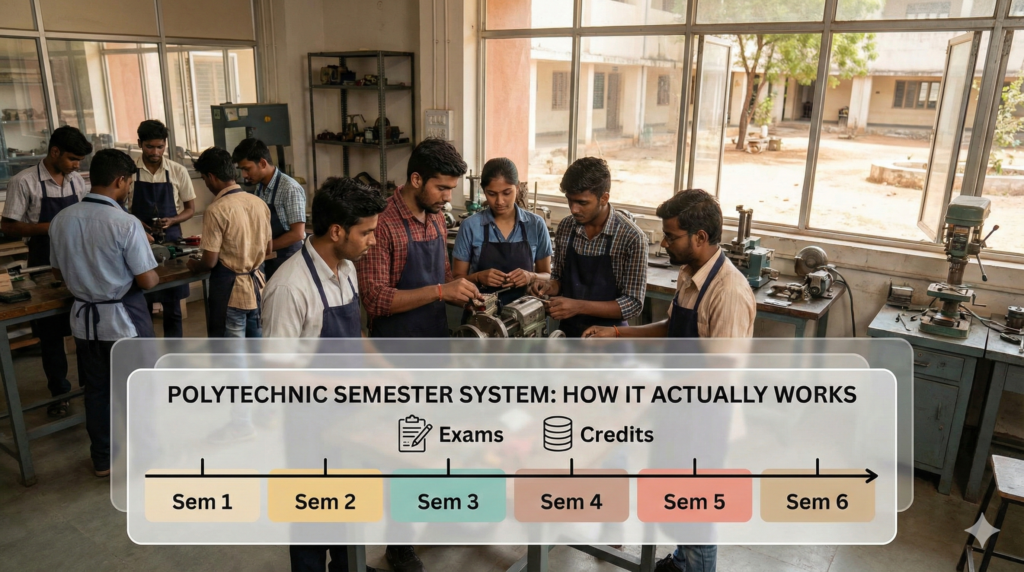
Why this matters: The modern Indian diploma is no longer about just securing 35 marks to pass. It is now a currency-based system where “time spent” equals “credits earned.” Failing to understand this new structure—specifically the ABC ID linkage and Bridge Courses—is the primary reason students face degree-withholding during Lateral Entry.
TL;DR: The Essentials
Marks vs. Credits: Your diploma is now worth ~120 credits. Failing a high-credit subject (like Math) damages your SGPA twice as much as failing a low-credit subject, even if both have the same marks.
The ABC ID is Mandatory: You cannot graduate without a “Green” status on your Academic Bank of Credits (ABC) account. A name mismatch between your Aadhaar and Class 10 marksheet is the #1 cause of credit transfer failures.
Lateral Entry Trap: If you plan to do B.Tech later, you must pass non-credit “Bridge Courses” (Mathematics) at the university level. Ignoring these “audit” subjects will prevent you from getting your engineering degree.
1. How the Credit System Actually Works
The Credit System replaces the traditional “percentage” model with a “weightage” model. In this framework, one credit represents 15 hours of theory or 30 hours of practical work accumulated over a semester. Unlike the old system where all 100-mark subjects were equal, the credit system ranks subjects by difficulty and time investment.
Practical Implication: If you score 40/100 in Engineering Mechanics (4 Credits) and 80/100 in English (2 Credits), your academic standing (SGPA) will drop significantly. Why? Because the low score in Mechanics carries double the weight in your final calculation. To maintain a high SGPA, you must prioritize high-credit technical subjects over easier, low-credit ones.
A side-by-side comparison of “Old Percentage Calculation” vs. “New SGPA Calculation” showing how failing a 4-credit subject impacts the final score more than a 2-credit subject.
2. NCrF Levels: Why You Are “Level 4.5”
Under the National Credit Framework (NCrF), education is a ladder. Knowing your “Level” is critical for students planning to study abroad or apply for Lateral Entry (Direct 2nd Year B.Tech).
Level 3.0: Class 10 (Entry point for Polytechnic).
Level 3.5: Completion of Diploma 1st Year (Equivalent to Class 11).
Level 4.0: Completion of Diploma 2nd Year (Equivalent to Class 12 Science).
Level 4.5: Completion of 3-Year Diploma.
The Lateral Entry Advantage: Because a Diploma holder is at Level 4.5 and a standard Class 12 student is at Level 4.0, universities grant you entry directly into the second year of engineering (Level 5.0). However, this 0.5 gap often requires you to take remedial exams, known as “Bridge Courses.”
3. The Digital Vault: ABC ID & Name Mismatch Errors
The Academic Bank of Credits (ABC) is a digital ledger linked to your Aadhaar and APAAR ID. It is not optional; your college deposits your “credits” here every semester. If your account is not active, your physical marksheet is technically invalid for future university verification.
The “Name Mismatch” Critical Failure
The most common error faced by polytechnic students is a mismatch between their Class 10 Marksheet name and Aadhaar Card name (e.g., Rahul S. Kumar vs. Rahul Kumar).
Actionable Fixes:
Aadhaar Update (Recommended): Update your Aadhaar name to exactly match your Class 10/Polytechnic registration name. This is the permanent fix.
Manual ABC Edit: If creating a new ABC ID via DigiLocker, you may get a one-time option to manually edit your name. Ensure it matches your college records character-for-character.
Institutional Mapping: If the mismatch persists, submit a written application to your college’s “Nodal Officer” requesting a backend mapping of your ABC ID to your Roll Number.
Title: “Credits Not Showing?” Flowchart steps: Check ABC ID -> Match Name with Aadhaar -> Is Name identical? -> (No) Update Aadhaar -> (Yes) Contact College Nodal Officer.
4. State-Specific Rules (The “Real” Constraints)
While the credit framework is national, the rules for passing and detention vary strictly by state.
Maharashtra (MSBTE ‘K’ Scheme): The SLA Trap
In the new ‘K’ Scheme, Self Learning Assessment (SLA) is a separate head of passing.
The Rule: You must pass the SLA component (micro-projects/assignments) separately.
The Trap: Even if you score 70/70 in the written theory exam, failing the SLA results in a subject failure. You cannot compensate for poor internal work with good exam scores.
Uttar Pradesh (BTEUP): SCA & Backlogs
Student Centered Activities (SCA): These are mandatory non-academic credits (discipline, games, NCC). You cannot receive your diploma without them.
Backlog Limit: To move to the next year, you generally need to clear at least 50% of your subjects. If you fail more than 50%, you face a “Year Back” (YB).
Karnataka (VTU/DTE): The Bridge Course Blockade
The Reality: Lateral entry students moving to B.E. (via VTU) must pass Additional Mathematics I & II (Codes like MATDIP301).
The Danger: These subjects carry 0 Credits for your degree calculation, so students often ignore them. However, VTU will withhold your degree indefinitely until you pass them, even if you have cleared all your core engineering subjects.
Tamil Nadu (DOTE ‘N’ Scheme): The 40% External Rule
Grading Split: Board exams are often converted to 75 marks.
Passing Rule: You need an aggregate of 40%, BUT you must also secure a specific minimum (usually 30/75 or 40/100) in the external board exam itself. High internal marks cannot save you if you fail the external threshold.
5. Lateral Entry: The “Bridge Course” Reality
Approximately 60% of diploma students aim for a B.Tech degree. While the 10% supernumerary quota (Direct 2nd Year) exists, the academic transition is not seamless.
The “Credit Deficit”: Diploma students miss the advanced calculus (Matrices, Multiple Integrals) taught in the 1st year of B.Tech.
The Solution: You are required to take “Bridge Courses” or “Audit Courses” in your 3rd Semester.
Workload Warning: A regular B.Tech student has 6 subjects. You will have 6 + 2 Bridge Courses. Prepare for a heavy 3rd Semester.
6. The “Exit” Myth: Is a 1-Year Certificate Worth It?
The Multiple Entry Multiple Exit (MEME) policy theoretically allows you to leave after 1 year with a certificate.
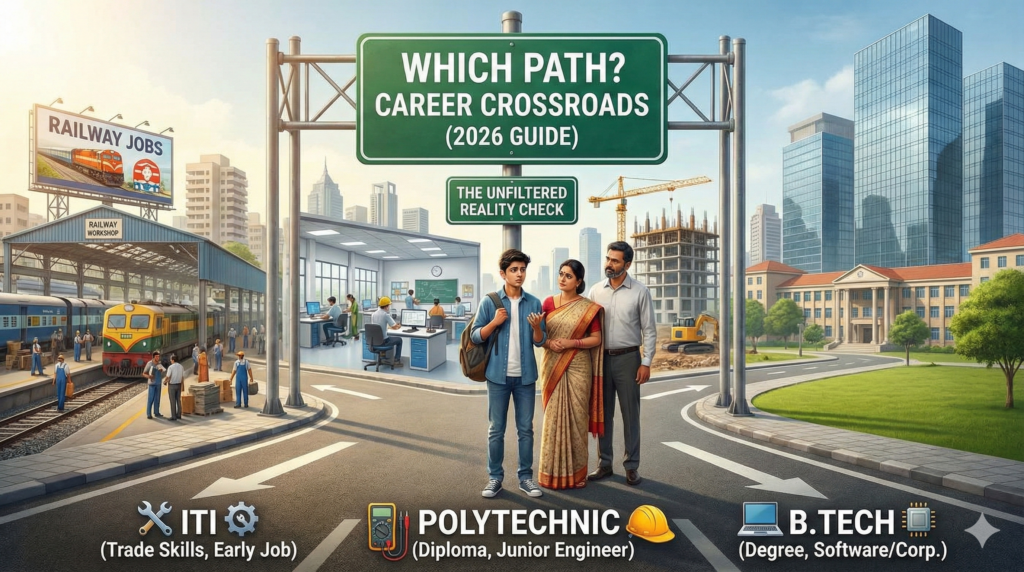
Editorial Advisory: In the current Indian job market (especially Tier-2/3 cities), a “1-Year Vocational Certificate” has negligible value for core engineering roles. Industries hire “Diploma Engineers” (3 years) or “ITI Technicians” (2 years). A 1-year exit certificate usually qualifies you only for semi-skilled helper roles. Do not exit early unless absolutely necessary.
FAQ: Common Student Queries
Q: Can I change my branch from Diploma to Degree (e.g., Civil to CS)?
A: Yes, AICTE allows branch migration during Lateral Entry. However, universities may impose extra bridge courses (like C-Programming) to cover the knowledge gap. It is academically difficult but legally possible.
Q: My ABC ID shows “0 Credits” even though I passed. Why?
A: This is usually due to a delay in your college uploading the bulk data or a name mismatch. If your name matches perfectly, wait 3-6 months. If the name differs, fix your Aadhaar immediately.
Q: Do NPTEL courses count towards my Diploma?
A: Yes. Many boards (like MSBTE and BTEUP) allow you to transfer credits from NPTEL/SWAYAM courses to earn an “Honors” degree or, in some cases, cover elective credits. Check your college’s specific list of approved NPTEL courses.
Q: What is Condonation?
A: Condonation is essentially “Grace Marks.” If you are failing a theory subject by a tiny margin (e.g., 2-3 marks), the board may pass you. However, your grade point for that subject is capped at the minimum passing level, which lowers your overall SGPA.
Conclusion: Making the Right Move
The Credit System is designed to reward consistency over last-minute cramming. Your strategy should be simple:
Fix your Identity: Ensure your ABC ID and College Record names match exactly.
Respect the Internals: In schemes like MSBTE ‘K’, ignoring micro-projects leads to direct failure.
Prepare for Math: If aiming for B.Tech, start studying Engineering Mathematics (Matrices/Calculus) during your final diploma semester to survive the Bridge Course.
About the Author This guide was researched and edited by a Technical Education Consultant with over 10 years of experience in counseling Indian polytechnic students and analyzing state board (MSBTE/BTEUP) regulations.