Author: Venkatesan Perumal, Senior Academic Analyst
Last Updated: January 16, 2026
If you are a student in Vijayawada, Warangal, or any Tier-2 city staring at your 10th class marks and wondering “What next?”, you are not alone. The brochure says one thing, but the reality at the job interview is very different.
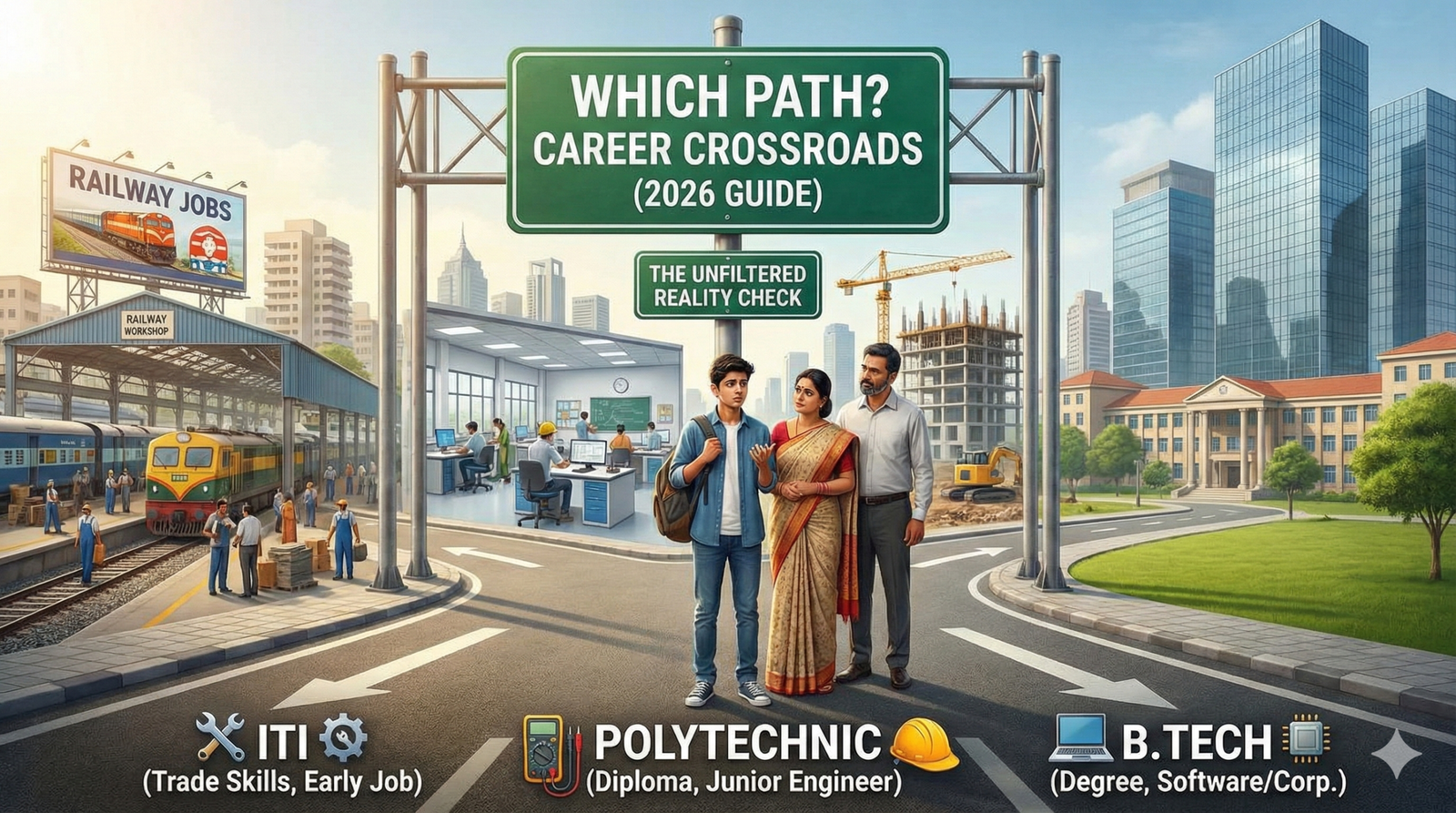
Should you take the quick route with ITI? The middle path with a Diploma? Or the prestigious B.Tech degree?
Here is the blunt truth: The market has flipped. A skilled ITI welder often finds a government job faster than a B.Tech graduate from a Tier-3 college. This guide breaks down the real costs, the real job market, and the real struggles students in Andhra Pradesh and Telangana face today.
⚡ Quick-Glance Summary
For the parent in a hurry:
Choose ITI if: You need a job immediately (Age 19-20). It is the fastest route to a Railway Govt Job due to the 20% reserved quota.
Choose Polytechnic if: You want a technical supervisor role or plan to jump into B.Tech (2nd year) later. It’s safer than Intermediate but harder than ITI.
Choose B.Tech if: You have the budget (₹10L+) and strong Maths skills. It is the only way to a high-paying IT/Corporate career, but Tier-2 college degrees are risky.
The “Fee Reimbursement” Trap: Government schemes (JVD/RTF) are helpful but often delayed by 6-12 months. Colleges may hold your certificates hostage.
1. The Reality Check: Official vs. Ground Reality
Government websites show you the rules. We show you what actually happens at the college counter.
| Feature | Official Rule | Student Reality (Ground Truth) |
| Course Cost | “Tuition Fee” is fixed by Govt. | You pay extra for Building Fund, Library, Records, and Placement Training. |
| Admission | Online Counselling (Web Options). | Colleges call you for “Spot Admission” and demand cash donations for better branches. |
| Certificates | Colleges cannot hold Original Certificates. | Colleges frequently withhold certificates until full fee dues are cleared, despite court orders. |
| Labs | “State-of-the-art Infrastructure.” | In many Tier-2 colleges, machines are often for display only. You learn on simulators, not real tools. |
| Attendance | 75% Mandatory. | Some private colleges charge a “Condonation Fee” (fine) of ₹500–₹2,000 to allow you to write exams if attendance is low. |
Counselor’s Note: In 2024-25, we saw many students in Telangana struggle because colleges refused to issue Transfer Certificates (TC) due to pending fee reimbursement from the government. Always keep a certified colour copy of your originals before submitting them.
2. ITI: The “Underdog” of Technical Education
Is it for you? Yes, if you want a Government job before you turn 21.
ITI (Industrial Training Institute) is often looked down upon, but it is currently the most strategic choice for students from lower-income families.
The “Railway” Advantage: The Indian Railways (RRB) reserves 20% of Level-1 (Group D) vacancies specifically for “Course Completed Act Apprentices” (CCAA). If you do ITI + Apprenticeship, you bypass the crowd.
The Cost: Negligible. Govt ITI fees are under ₹5,000/year.
The Trade Trap: Not all trades are equal.
Hot Trades: Electrician, Fitter, Diesel Mechanic (High Govt Demand).
Cold Trades: COPA, Civil Draughtsman (Lower demand in Tier-2 cities).
State-Specific Update (2025):
Telangana: The government has upgraded 65 ITIs into Advanced Technology Centers (ATCs) with Tata Technologies. They now teach Electric Vehicle (EV) mechanics and Robotics. This is a massive upgrade from the old syllabus.
3. Polytechnic: The Middle-Class Safety Net
Is it for you? Yes, if you hate “theory” but love “machines.”
Polytechnic (Diploma) is a 3-year course you join after Class 10 via POLYCET. It makes you a “Junior Engineer.”
The “Math Gap” Warning: Many Diploma students join B.Tech later via the ECET (Lateral Entry) exam. Warning: Diploma students often fail B.Tech Maths (M1, M2, M3) because the Diploma syllabus doesn’t teach advanced calculus. If you hate Maths, think twice before planning for B.Tech later.
Job Market: High demand in construction, manufacturing, and power sectors (transmissions/sub-stations).
Salary Reality: Starting salary is ₹15,000 – ₹22,000. Growth is slow unless you get a B.Tech degree later.
Admission Alert 2025:
AP POLYCET: Notification expected in Feb/March. Apply via
polycetap.nic.in.TS POLYCET: Application usually starts in March. Apply via
polycet.sbtet.telangana.gov.in.
4. B.Tech: The Corporate Dream (and Nightmare)
Is it for you? Yes, if you want a white-collar job and can afford the risk.
B.Tech is the standard “Degree.” But in 2026, the gap between a “Tier-1” college (IIT/NIT/Top Private) and a “Tier-3” college (Local Engineering College) is massive.
The Employability Crisis: Only 45-50% of engineers are considered employable. The rest struggle because their colleges lack coding culture or modern labs.
The “Category B” Seat Scam: Many parents pay ₹5 Lakhs to ₹10 Lakhs donation for a seat in a top college. Analysis: If you spend ₹15 Lakhs on a degree to get a ₹3 Lakh/year job, the ROI (Return on Investment) takes 10 years. Do the math before you pay.
Hidden Fees: Private colleges often charge ₹20,000+ annually for “CRT” (Campus Recruitment Training), which is mandatory.
State-Specific Update:
Telangana: The 25% Intermediate weightage for EAMCET rank has been removed. Your rank now depends 100% on your entrance exam score. This helps students who focused only on EAMCET.
5. Decision Framework: Who Are You?
Don’t just follow your friends. Match your profile to the path.
👤 Persona A: Ravi (The Economic Pragmatist)
Situation: Family income is low (< ₹1 Lakh). Needs to earn quickly. Average in studies.
Recommended Path: ITI (Electrician/Fitter) + Railway Apprenticeship.
Why? Low cost. Guaranteed stipend during apprenticeship. High chance of Railway job by age 22.
👤 Persona B: Sravani (The Hands-On Learner)
Situation: Good at practicals, hates memorizing theory. Wants to be an engineer but fears the Intermediate pressure.
Recommended Path: Polytechnic (Diploma) -> Lateral Entry B.Tech.
Why? She skips the stress of Inter exams. She gets a practical foundation. She enters B.Tech directly in the 2nd year.
👤 Persona C: Arjun (The Corporate Aspirant)
Situation: Strong in Maths. Dreams of working at Google/Microsoft. Family can support education for 4-6 years.
Recommended Path: Intermediate (MPC) -> B.Tech (CSE/IT).
Why? Top IT companies prefer the 4-year B.Tech route. The theoretical Maths in Intermediate is crucial for cracking coding algorithms.
6. State-Wise “Fee Reimbursement” Reality Check
If you rely on JVD (AP) or Fee Reimbursement (TS), read this.
| State | Scheme Name | Status & Delays (As of 2024-25) |
| Andhra Pradesh | Jagananna Vidya Deevena (JVD) | Funds are credited to the mother’s bank account. Delays of 3-6 months are common. Ensure the account is active and KYC compliant. 13
|
| Telangana | Fee Reimbursement Scheme | Funds go directly to the college. Huge backlog of dues. Private colleges frequently protest and withhold certificates of outgoing students until the Govt pays. 14
|
Counselor’s Advice: Do not treat reimbursement as “guaranteed cash.” Have a backup fund of ₹20,000–₹30,000 for exam fees and emergencies that the scheme won’t cover.
Conclusion: The “Better” Job Depends on You
For Stability: Go for ITI. The government protects these jobs.
For Growth: Go for B.Tech. The private sector pays for skills, not just degrees.
For Safety: Go for Polytechnic. It keeps both doors open.
Final Verdict: In 2026, a skilled technician is worth more than an unskilled engineer. Choose the path where you can actually learn, not just the one that sounds good at a wedding.
References & Sources:
NCVT MIS Portal (2024) – ITI Curriculum updates.
Directorate of Employment and Training, Telangana (2025) – Admission Notifications.
Tata Technologies & Telangana Govt MoU (2024) – ATC Upgrades.
The Hindu (2024) – Reports on ATC inauguration.
New Indian Express (2024) – Report on Peddapalli ITI infrastructure.
Department of Technical Education, AP (2025) – POLYCET Guidelines.
SBTET Telangana (2025) – POLYCET Notification.
India Skills Report 2026 – Employability statistics.
APSCHE/TSCHE Guidelines (2025) – ECET and EAMCET rules.
Railway Recruitment Board (RRB) Notifications (CEN 02/2024) – ALP/Technician Eligibility.
Times of India (2025) – Engineering employability reports.
Andhra Pradesh Gazette (2024) – JVD fund release orders.
Telangana High Court Orders (2024/2025) – Regarding certificate retention by colleges.