By Ashok Kumar, Academic Counselor & Polytechnic Analyst (15+ Years Experience)
If you are reading this, you are likely holding a Rank Card and feeling the pressure. The transition from SSC (10th Class) to a Polytechnic Diploma is not just about choosing a subject; it is about choosing your livelihood for the next 40 years.
Most students make decisions based on what their friends are doing or what “sounds” good. This guide stops you from making those mistakes. We treat your rank like a budget and your branch like an investment.
Here is your emergency decision framework.
Quick-Glance: The “Emergency Card”
Read this first if you have to enter Web Options today.
| Your Primary Goal | The Direct Action |
| “I need a Govt Job ASAP.” | Select Civil or Electrical (EEE). These branches have the highest vacancy ratios in RRB JE and State Electricity Boards. |
| “I want a High Salary in IT.” | Select CSE or ECE, only if you get a Top-Tier Government Polytechnic (e.g., Masab Tank, Kakinada). In Tier-2 colleges, IT placements are often low-paying BPO roles. |
| “I plan to do B.Tech later.” | Choose Interest over “Scope”. You need high marks (80%+) in Diploma to get a top Engineering college via ECET. It is easier to score high in a subject you actually like. |
| “My Rank is Low (50,000+).” | Look for Niche Branches like Chemical, Textile, or Ceramic Tech. These have lower cutoffs but guaranteed jobs in industrial hubs like Vizag or Warangal. |
| “I have no money for fees.” | Verify Jagananna Vidya Deevena (AP) or ePASS (TS) eligibility. Ensure your Income Certificate is dated correctly (Post Jan 1, 2022 for AP). |
Step 1: The Self-Audit (Rank vs. Reality)
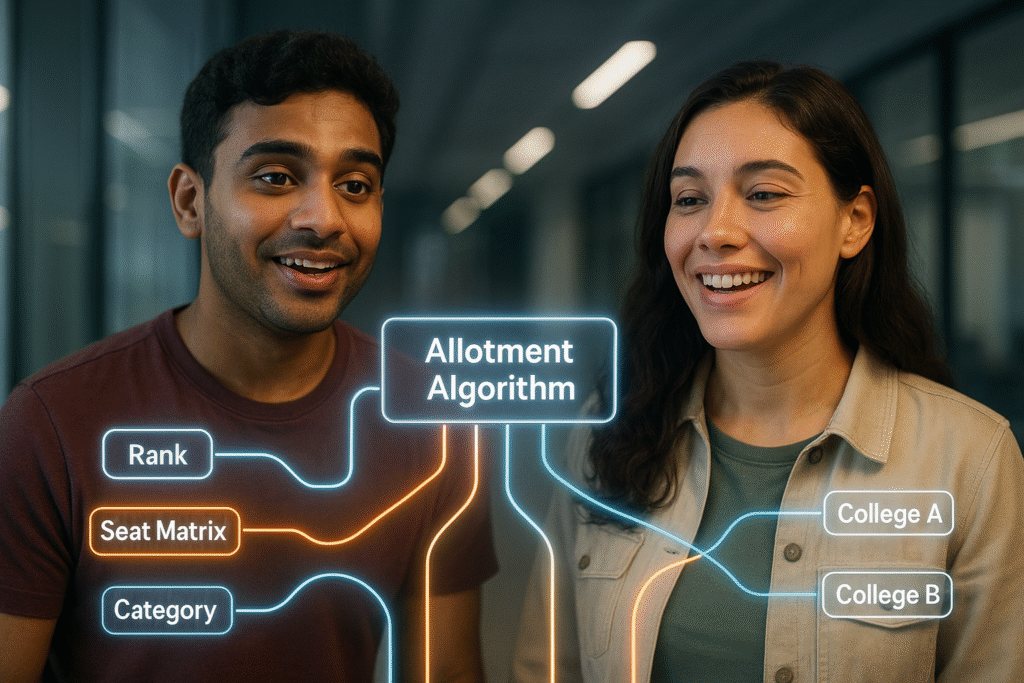
Do not look at the “General” cutoff if you have a reservation category. The gap is massive.
The Rank Zones
The Golden Zone (Ranks 1 – 5,000): You have a “blank cheque.” Prioritize the College Brand (Infrastructure/Labs) over the branch. Top colleges like Govt Polytechnic Hyderabad or Andhra Polytechnic Kakinada offer peer groups that will push you toward better ECET ranks.
The Strategic Zone (Ranks 5,001 – 25,000): You face a trade-off: Top College + Lower Branch OR Tier-2 College + Top Branch.
Our Advice: If you want a job immediately, pick the Top Branch (Mech/Civil). If you want B.Tech, pick the Top College.
The Danger Zone (Ranks 40,000+): Avoid private colleges promising “100% Placement” with high hidden fees. Look for Government Colleges in district headquarters (e.g., Srikakulam, Nizamabad) or specialized courses.
Counselor’s Note: “I’ve seen students with a 60,000 rank get into top Government colleges simply because they chose ‘Ceramic Technology’ or ‘Packaging Tech’. These courses often have 100% employment because there are so few graduates.”
Step 2: Branch Selection (If… Then… Framework)
Use this logic tree to finalize your branch. Do not guess.
1. Civil Engineering
Official Status: The King of Government Jobs.
The Reality: Great for Govt recruitment (RRB/SSC JE), but private sector starting salaries are low (₹12k-₹15k) and involve hard labor in the sun.
If you can study for competitive exams for 2-3 years after Diploma, Then choose Civil.
2. Mechanical Engineering
Official Status: Evergreen Branch.
The Reality: Industrial hubs like Anantapur (Kia Motors) and Hyderabad (Aerospace) need diploma holders for assembly and maintenance. Physical endurance is required.
If you want to work with machinery and are open to shift work, Then choose Mechanical.
3. Electrical (EEE)
Official Status: Best for State Power Boards (Transco/Genco).
The Reality: Mathematically the toughest diploma course. Many students struggle to clear backlogs.
If you are strong in Math and Physics, Then choose EEE.
4. Computer Science (CSE)
Official Status: The “Boom” Branch.
The Reality: The Diploma curriculum often lags behind the industry. Without a B.Tech (Lateral Entry), career growth hits a ceiling quickly.
If you are 100% sure about doing B.Tech later, Then choose CSE.
Step 3: The “Name-Sake” Trap (Critical Warning)
This is the most common mistake during Web Options entry.
The Trap:
Colleges often have confusingly similar names.
College A: Chaitanya Institute of Science & Technology (Code: CIST)
College B: Chaitanya Engineering College (Code: CECV)
One might be a top-tier institute; the other might be a shed with no labs.
The Fix:
Download the PDF List of Colleges from
polycet.ap.gov.inortgpolycet.nic.in.Search by CODE, not by Name.
Write the codes on paper before logging in.
Step 4: The Money Talk (Fee Reimbursement Reality)
Government policies promise free education, but the ground reality involves cash flow management.
Andhra Pradesh: Jagananna Vidya Deevena (JVD)
The Policy: 100% Tuition fee credited to the Mother’s Bank Account in four quarters.
The Friction: Colleges often pressure students to pay upfront if the government release is delayed. If the mother uses the money for household expenses, the student’s hall ticket may be blocked.
Action: Ensure your mother’s bank account is active and seeded with Aadhaar.
Telangana: ePASS
The Policy: Tuition fee reimbursed directly to the college.
The Friction: 75% Biometric Attendance is mandatory every month. If you skip college to work a part-time job, your scholarship stops, and you must pay the full fee (~₹25,000) from your pocket.
Counselor’s Note: “Parents in AP must keep a contingency fund of ₹10,000. Delays in JVD credits are common, and colleges will not let you sit for exams without dues clearance.”
Step 5: The Exit Strategy (B.Tech Lateral Entry)
The ECET Math Hurdle
Diploma students join B.Tech directly in the 2nd year. However, they miss the 11th and 12th-grade Math (Calculus) foundation.
The Consequence: Many diploma students fail M1, M2, and M3 subjects in B.Tech, leading to backlogs and ineligibility for campus placements.
The Fix: Start a “Bridge Course” in Mathematics via YouTube (Channels like Khan Academy or Professor Leonard) during your final year of Diploma. Do not wait for B.Tech to start.
The Reality Check Table
We compared the brochure claims vs. what actually happens on campus.
| Feature | Brochure Promise | Student Reality |
| Placements | “100% Placement Assistance” | In Tier-2/3 colleges, this often means a ₹10k job in a call center or as a helper. Core jobs are rare. |
| Labs | “State-of-the-art Equipment” | Many private college labs are “showpieces.” You might graduate Mechanical Engineering without touching a CNC machine. |
| Hostels | “Attached Hostels” | Govt hostel seats are limited (priority to SC/ST). OC/BC students often end up in private PGs costing ₹4,000/month. |
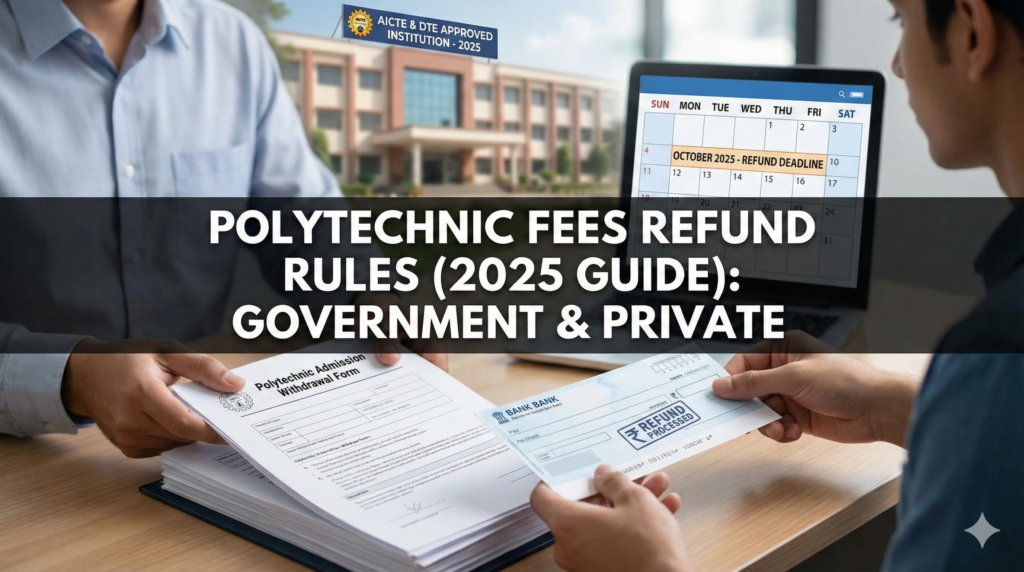
| Refunds | “Easy Cancellation” | Getting a refund after paying a private college is a nightmare involving months of follow-up. |
Final Verdict: What Should You Do?
Check Your Category Rank: Do not panic looking at Open Category cutoffs.
Verify College Codes: Triple-check the 4-letter code before freezing options.
Get Income Certificate: Ensure it is valid (Post Jan 1, 2022 for AP) to save ₹75,000+ in fees over 3 years.
Disclaimer: Admission rules, fee reimbursement policies (JVD/ePASS), and dates are subject to change by the State Boards (SBTET AP/TS). Always verify with the official notifications at polycet.ap.gov.in or tgpolycet.nic.in.
About the Author
Ashok Kumar is an Academic Counselor with over 15 years of experience in the Indian Technical Education sector. Specializing in the AP/Telangana region, they have guided over 10,000 students through the POLYCET and ECET maze, helping families secure government seats and fee reimbursements.
Sources & Citations
1 SSC JE & Government Job Vacancy Data (2024-25)
3 AP & TS POLYCET 2024 Cutoff Data
6 Jagananna Vidya Deevena & ePASS Guidelines (Official G.O.s)
JNTU Academic Regulations & Lateral Entry Norms
Industry Salary Reports (Kia Motors, Divis Labs)