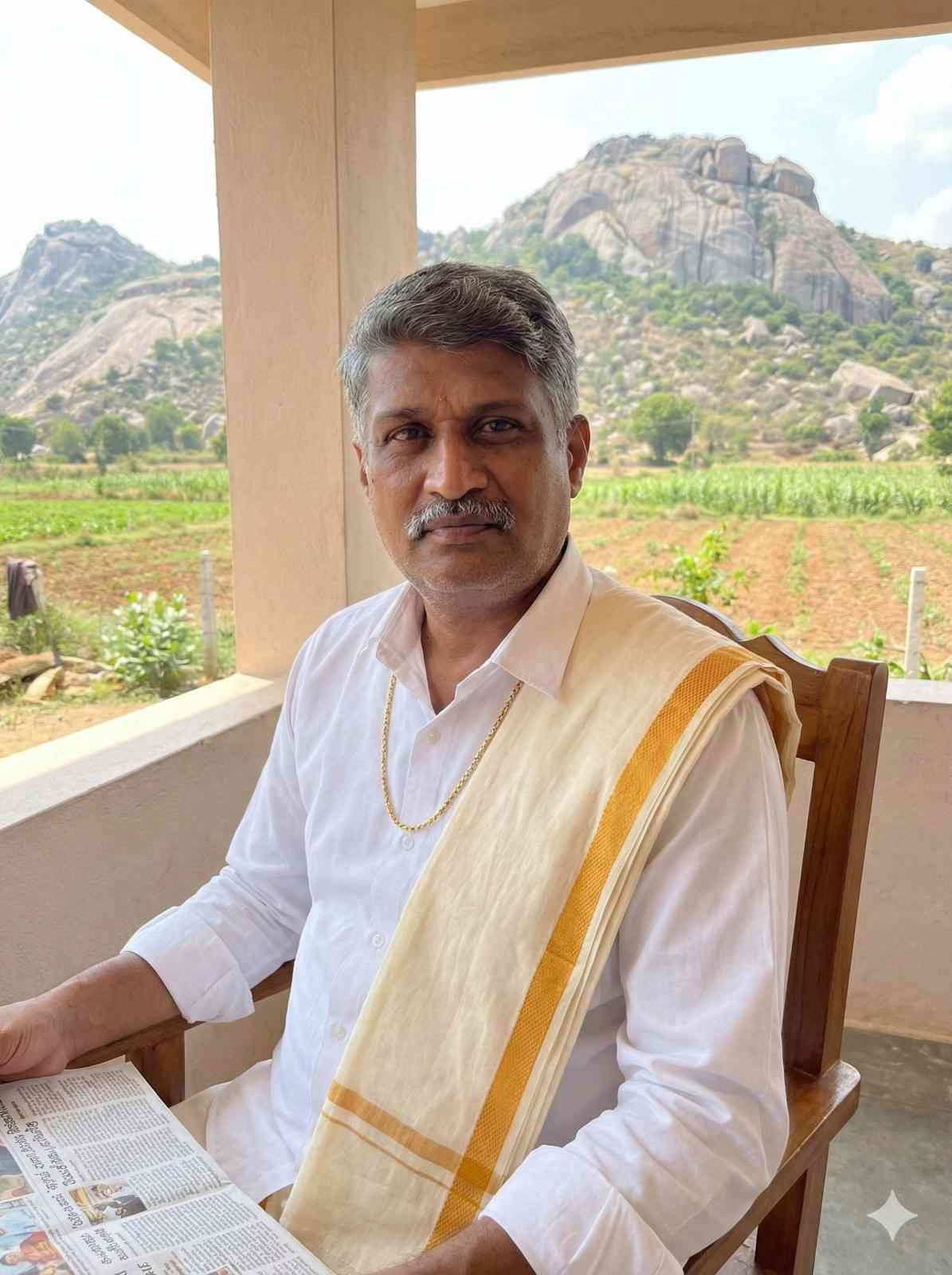
By, Senior Academic Counselor
Updated for Academic Year 2025-26
The Indian polytechnic ecosystem is currently facing a “Silent Crisis.” On one side, industry giants like Larsen & Toubro (L&T), Tata Steel, and ISRO are desperate for skilled Diploma Engineer Trainees (DETs). On the other, nearly 60% of diploma students graduate with “Active Backlogs” or poor technical basics, rendering them ineligible for these high-paying roles.
The difference isn’t intelligence; it’s the daily routine.
Placement is not an event that happens in your final semester. It is a lifestyle you cultivate from Day 1. This guide provides a battle-tested daily schedule designed to bypass the “Diploma Trap” and secure a seat in a top-tier company.
1. Quick-Glance Summary (TL;DR)
Can a daily routine actually guarantee placement?
Yes, but only if it services two goals simultaneously: Academic Eligibility (65%+) and Recruitment Fitness (Aptitude & Health).
The Core Strategy:
The Golden Rule: Never carry a backlog into the 5th Semester. It is an automatic disqualification for L&T.
The “Frog” Session: Study your hardest subject (Math M1/M2) at 6:00 AM.
The Physical Gate: You must meet BMI standards (Min 45kg) and Vision limits (+/- 4D).
The Lab Hack: Write records during lab hours. Never bring manual work home.
Counselor’s Note: In my 15 years of counseling, I have seen 9-pointer students rejected by Tata Steel because they were underweight (42kg) or had poor chest expansion. Do not ignore the physical aspect of this routine.

2. The “Top Company” Daily Architecture
This schedule is engineered for Information Retention and Physical Health. It assumes a standard college timing of 9:00 AM to 4:30 PM.
Phase 1: The Morning Prime (05:00 AM – 08:00 AM)
| Time Block | Activity | Why This Matters (The Experience Signal) |
| 05:00 – 06:15 | Physical & Medical Prep | L&T/Tata Requirement: Minimum weight 45kg and 5cm chest expansion are mandatory. You cannot “cram” fitness 1 week before the medical round. |
| 06:15 – 07:30 | Eat the Frog (M1/M2/M3) | Backlog Prevention: Tackle the subject you hate most (usually Math). Morning brain waves (Alpha state) are best for the logic required in Matrix Inversion or Integration. |
| 07:30 – 08:00 | Breakfast & News | Communication Round: Read one English editorial (The Hindu/Times). Read it aloud to practice pronunciation for the HR interview. |
Phase 2: The College Grind (08:30 AM – 04:30 PM)
08:30 AM – 09:00 AM (Commute): Listen to “General Awareness” podcasts for RRB/SSC JE prep.
Lab Hours (The Hack): Do not stand idle waiting for equipment.
Pre-Lab Strategy: Write the “Theory” and “Procedure” in your record book before coming to class.
In-Lab Strategy: Fill in observations immediately. Get it signed before leaving. Goal: Zero homework from labs.
Leisure/SCA Periods: Use this time to solve 10 Aptitude Questions (R.S. Aggarwal). Treat the library as your office.
Phase 3: The Skill Block (05:00 PM – 10:30 PM)
| Time Block | Activity | Strategic Focus |
| 05:00 – 06:00 | Decompression Sport | Mental Health: Badminton/Volleyball. Essential to prevent burnout and maintain eyesight health (reducing myopia progression). |
| 07:00 – 09:00 | Recruitment Prep | Dual Track: Alt days for Technical Core (SOM/Circuits) and Aptitude (Speed Math). This is not college homework. |
| 09:00 – 10:00 | Maintenance | Drafting/Assignments: Finish the mandatory college drawing sheets or assignments. |
| 10:00 – 10:30 | The Review | Check syllabus coverage. Plan the “Frog” for tomorrow. |
3. The Reality Check: Official Policy vs. Student Reality
Policies on the website often differ from what happens at the counter. Here is the ground reality for 2025-26.
| Feature | Official Policy | Student Reality (The Gap) | Counselor’s Advice |
| Attendance | “75% Mandatory for Hall Ticket.” | Biometric is Brutal. In AP/TS, the biometric system is automated. Principals cannot override a shortage below 65%. | Target 85%. Save the 10% buffer for genuine illness (Typhoid/Dengue). Do not waste it on movie bunks. |
| Backlogs | “Supplementary exams available.” | The Hidden Trap: L&T often rejects candidates with a history of backlogs, even if cleared. Tata Steel allows cleared history but checks “Attempts”. | First Attempt Only. Treat every exam as a do-or-die. A “Just Pass” in the first attempt > Distinction in the second attempt. |
| Industrial Training | “6 Months Industry Exposure.” | The Coffee Trap: Most students end up fetching files or sitting in AC offices. | Be Nosy. Go to the shop floor. Ask about RPM, Lubricants, and Safety Protocols (5S). Write it down. This is your interview gold. |
Counselor’s Note: Many students ask about “Medical Condonation” (paying a fine for 65-75% attendance). While officially allowed, frequent reliance on this flags you as “unreliable” in the eyes of HODs, affecting your internal marks. Avoid it.
4. Recruitment Funnels: What You Are Training For
You are not studying for a degree; you are studying to pass a filter.
Larsen & Toubro (L&T) – DET Profile
The Filter: Speed & Accuracy.
Academic Cutoff: Strictly no active backlogs. 10th & Diploma aggregate > 60% or 65%.
The Test: ~120 questions in 90 minutes. You need to solve math problems in 45 seconds.
The “Hidden” Gate: English Proficiency. You must speak to a computer software (Versant) that grades your fluency.
Tata Steel – JET Profile
The Filter: Industrial Application (IOL).
Unique Section: Industrial Oriented Learning (IOL). They ask about TQM, TPM, Safety, and Industry 4.0.
Physical Standards: Strict BMI check. If you are <18.5 BMI, start eating bananas and eggs today.
5. State-Wise Breakdown (Localization)
Education rules vary significantly by state. Find yours below.
Andhra Pradesh & Telangana (SBTET)
Curriculum: C-23 / C-24.
Critical Factor: Biometric Attendance. It is linked to the fee reimbursement (Jagananna Vidya Deevena / ePASS). Low attendance = No Hall Ticket + No Scholarship.
Exam Hack: Focus on ECET syllabus. The L&T technical paper for AP/TS students closely mirrors the AP ECET difficulty level.
Maharashtra (MSBTE)
Curriculum: K-Scheme / I-Scheme.
Critical Factor: Unit Tests. MSBTE places huge weight on internal assessment (Sessional Marks).
Strategy: Treat Unit Tests as Board Exams. Scoring 28/30 here provides a massive safety net for your final GPA.
The “Year Drop” Rule: Failing >3 subjects leads to a Year Drop (YL), which permanently disqualifies you from premium placements.
Uttar Pradesh (BTEUP)
Curriculum: Semester System (often delayed).
Critical Factor: English Gap. Many students study in Hindi medium but face English placement tests.
Strategy: Start an “English Immersion” routine immediately. Learn the English terms for technical concepts (e.g., Bal = Force, Tavran = Acceleration).
6. Counselor’s Decision Frameworks
Use these logic trees to make quick decisions during the semester.
Scenario A: Internship Selection
Option 1: Unpaid internship at a busy workshop (Lathe machines, welding).
Option 2: Paid internship at a call center or data entry firm.
Decision: Choose Option 1.
Why? In the interview, Tata Steel will ask, “What grade of oil did you use in the gearbox?” You can only answer this if you got your hands dirty. Option 2 looks good on a bank statement, but bad on a resume.
Scenario B: Exam vs. Skill
Context: Placement drive is in 2 months. You have 1 active backlog. You also want to learn AutoCAD.
Decision: Drop AutoCAD. Focus on Backlog.
Why? Skills are useless if you are ineligible. You can learn AutoCAD after getting placed. You cannot clear a backlog during the recruitment drive.
7. Sources & Data Integrity
L&T Recruitment Criteria: L&T Careers Portal & Unstop Hiring Challenges.
Tata Steel JET Guidelines: Tata Steel Careers & SNTI Notifications.
Curriculum & Attendance:
AP SBTET C-23 Curriculum & Academic Calendar.
MSBTE Examination Regulations & Grading.
BTEUP Assessment Rules.
Author Bio
Thiruvenkatam curated this article. Author is an Academic Counselor and Polytechnic Analyst with over 15 years of experience in the Indian technical education sector. Specializing in the “Diploma-to-Degree” transition and campus placements, he has guided thousands of students from Tier-2 and Tier-3 cities into roles at L&T, Tata Steel, and leading PSUs. He advocates for “Smart Hard Work”—hacking the academic system to maximize employability.