1. Your Pathway to Germany Starts Here
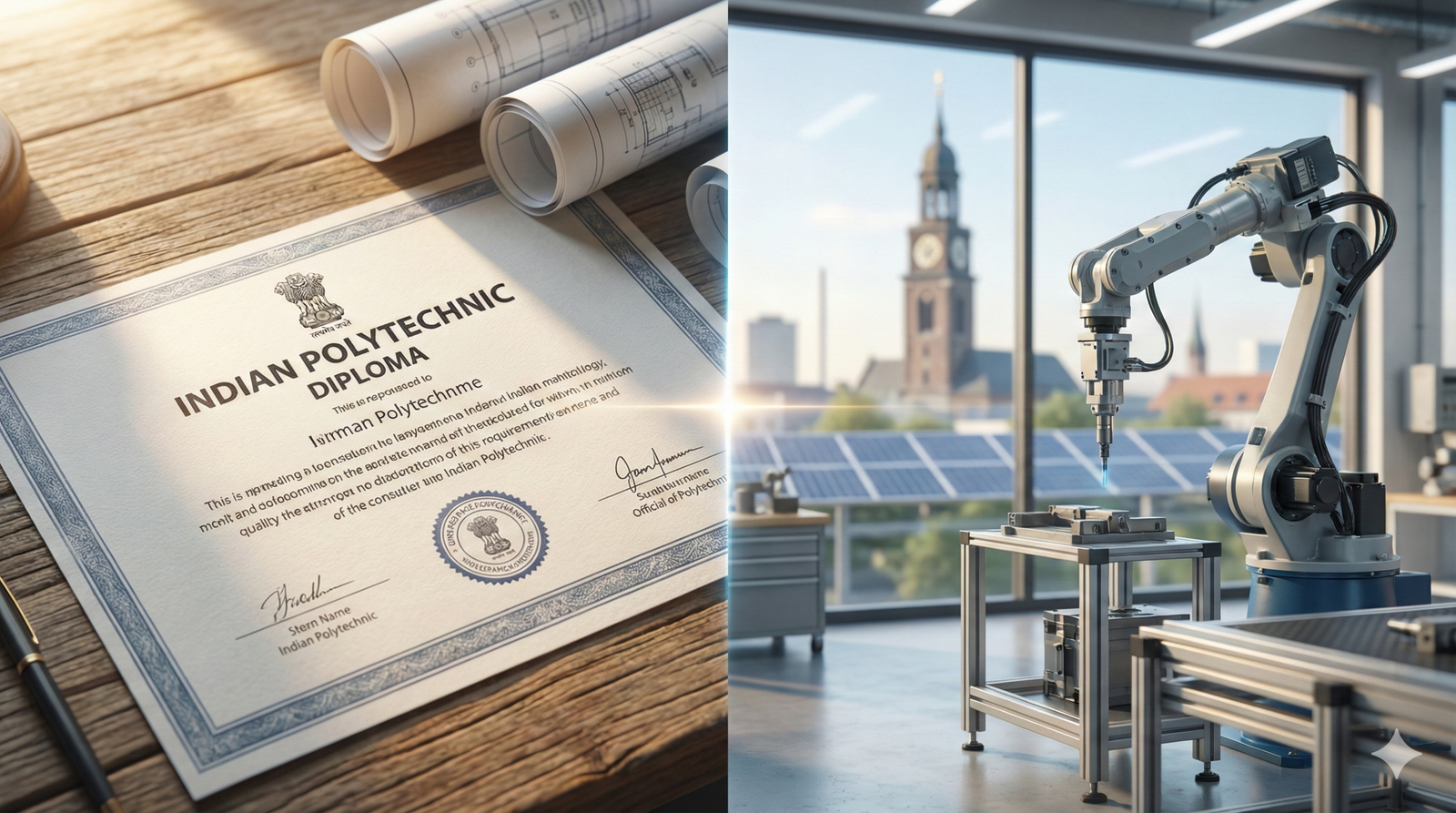
You finished your 3-year Polytechnic Diploma. You have hands-on technical skills that most 12th-pass applicants simply don’t have. Now it’s time to use that edge to land one of the most sought-after opportunities in Europe — a Dual Vocational Training (Ausbildung) in Germany.
Here’s the deal: Ausbildung is not just a “job training program.” It is a legally recognized, government-structured apprenticeship where you earn a monthly stipend (€620–€1,200+) while studying in a vocational school (Berufsschule) and working for a real company — simultaneously. At the end of 2–3 years, you hold a German vocational qualification recognized across the EU, a work visa pathway, and often a full-time job offer from the very company that trained you.
For Indian Polytechnic Diploma holders, this path is especially powerful. Your diploma already covers foundational subjects in Electrical, Mechanical, Civil, IT, or Electronics engineering — subjects that map directly onto high-demand Ausbildung trades like Mechatroniker, Fachinformatiker, Elektroniker, and Anlagenmechaniker. German employers notice that. It gives you a credibility advantage from the moment your application lands in their inbox.
This guide walks you through every single step — from your language certificate to your visa appointment — with no fluff.
2. The Absolute Prerequisites (Before You Apply for Anything)
Before you open a single job portal, these two prerequisites must be non-negotiable checkboxes.
German Language: Your Single Most Important Asset
This is where most Indian applicants make a fatal mistake — they start searching for Ausbildung positions before learning the language. Don’t do this.
German companies conduct their interviews, their onsite training, and their daily operations entirely in German. An employer in Stuttgart or Hamburg is not going to switch to English for you. Reaching B1 level minimum (B2 strongly preferred) before you apply is mandatory, not optional.
Accepted German language certificates:
- Goethe-Institut (most widely recognized globally, highly trusted by German companies)
- ÖSD (Österreichisches Sprachdiplom Deutsch)
- TELC Deutsch (Test of English as a Foreign Language equivalent, widely used for visa purposes)
The Goethe-Institut has exam centers across India — in Delhi, Mumbai, Chennai, Kolkata, Pune, and Bangalore. Start your German classes immediately if you haven’t already. Reaching B2 from scratch typically takes 12–18 months of consistent study. Plan accordingly.
Pro tip: Even after your B2 certificate, keep practicing. Watch German YouTube channels (Easy German is excellent), consume German news via Deutsche Welle, and find language exchange partners on Tandem or HelloTalk. Your conversational fluency in the interview will make or break your application.
Diploma Recognition: Getting Your Credentials Evaluated
Germany does not automatically accept foreign qualifications at face value. Before applying, you need to understand how your Indian Polytechnic Diploma will be assessed.
Two key resources:
- Anabin Database (anabin.kmk.org): This is the official German database maintained by the Standing Conference of the Ministers of Education. Search for your institution and diploma type here to check whether it’s recognized, partially recognized, or requires further evaluation. Most 3-year Indian Polytechnic Diplomas fall under “partial recognition” — meaning they are acknowledged but may not be equivalent to a full German Berufsausbildung.
- IHK FOSA (Foreign Skills Approval): For technical and commercial qualifications, the IHK FOSA (a specialized unit of the German Chambers of Commerce) formally evaluates whether your Indian diploma is comparable to a German vocational qualification. Applying for this evaluation early — even before your job search — strengthens your application significantly.
Having an IHK FOSA evaluation letter in your application package signals to a German employer that you are serious, organized, and have already taken professional steps. It dramatically increases your callback rate.
3. The 5-Step Application Process
Step 1: Build a German-Style Profile
Your Indian-style resume will not work in Germany. A document listing “Objective: To secure a challenging position in a reputed organization…” will get deleted within 10 seconds. German employers have a very specific, standardized format they expect.
Create a Europass CV (Lebenslauf):
The Europass CV is the pan-European standardized resume format. You can build one for free at europass.eu. Here’s what German employers expect in a Lebenslauf:
- A professional photo in the top-right corner (this is standard and expected in Germany, unlike in the UK or USA)
- Reverse chronological order — most recent education/experience first
- Clear sections: Personal Information, Education (Ausbildung), Work Experience, Skills, Language Skills, Certifications
- Clean, minimal design — no decorative graphics or colored infographic-style layouts
- Typically 1–2 pages maximum
Write a highly customized Cover Letter (Anschreiben):
Every single application needs its own Anschreiben. A generic cover letter is instantly spotted and discarded. Your Anschreiben must:
- Be written entirely in German
- Reference the specific company and specific position you are applying for
- Explain why your Indian Polytechnic background makes you relevant for this role at this company
- Be formal in tone — address the hiring manager by name if possible (check LinkedIn or the company website: “Sehr geehrte Frau Müller” or “Sehr geehrter Herr Schmidt”)
- Stay within one page (3–4 short paragraphs)
Use tools like DeepL to refine your German phrasing, but have a native speaker or a German tutor review your letter before mass-applying. A poorly written Anschreiben signals exactly the B1 level German you’re trying to hide.
Step 2: Find the Right Employers
These are the top portals where you can search for and apply to Ausbildung positions directly from India:
- Azubi.de — Germany’s largest dedicated Ausbildung portal. Use the filter “Ausbildungsstart” (start date) and location to narrow results.
- Ausbildung.de — Another major portal with strong company profiles and direct application options.
- Make-it-in-Germany (make-it-in-germany.com) — The official German government portal for international applicants. Specifically designed for people applying from abroad.
- StepStone.de — Broader job board but has a dedicated Ausbildung section with large company listings (Siemens, Bosch, Deutsche Bahn, etc.).
- Indeed.de — Filter by “Ausbildung” in the job title field.
- LinkedIn — Search “Ausbildung” + your field. Many medium-sized companies (Mittelstand) post here and are open to international candidates.
Critical filter to use: When applying from India, specifically look for companies that mention “Bewerbungen aus dem Ausland willkommen” (applications from abroad welcome) or “internationale Bewerber” (international applicants). Larger corporations — especially in the automotive, IT, logistics, and manufacturing sectors — are generally more equipped to sponsor your visa than very small local businesses.
Target industries where your Polytechnic background translates best:
- Mechatronics (Mechatroniker/in)
- IT Systems Integration (Fachinformatiker/in – Systemintegration)
- Industrial Mechanics (Industriemechaniker/in)
- Electronics for Industrial Engineering (Elektroniker/in für Betriebstechnik)
- Technical Product Design (Technische/r Produktdesigner/in)
Step 3: Send Applications and Follow Up Strategically
Set a realistic expectation right now: you will likely need to send 50–100+ applications before receiving your first contract offer. This is not a failure — this is normal, even for German applicants. The Ausbildung market is competitive, and employers receive hundreds of applications per opening.
Timeline is everything:
Most Ausbildung contracts in Germany begin in August or September. German companies open their applications 6 to 8 months in advance — meaning the serious application window runs from October through February for the following year’s intake.
Application calendar to follow:
| Month | Action |
|---|---|
| October–November | Begin mass applications for the following August intake |
| December–January | Follow up on applications sent; continue applying |
| February–March | Interviews happening; second round of applications |
| April–May | Contract offers and signings |
| June–July | Visa application window |
| August–September | Ausbildung begins |
How to follow up:
If you haven’t heard back within 3 weeks, send a brief, polite follow-up email in German. Something as simple as: “Sehr geehrte Damen und Herren, ich möchte mich bezüglich meiner Bewerbung vom [Datum] erkundigen…” shows initiative, which German employers appreciate.
Step 4: Ace the Online Interview
Once a company shortlists you, they will schedule a video interview (often via Teams or Zoom). Here are three things that will determine whether you move forward:
1. Be ruthlessly punctual. Germans treat punctuality as a form of respect. Log into the video call 5 minutes early. Test your camera, microphone, and internet connection the night before. A technical failure due to poor preparation is an immediate red flag to a German employer.
2. Speak German — however imperfect — confidently. Don’t switch to English the moment you struggle for a word. Use filler phrases like “Moment bitte, ich überlege kurz” (One moment please, let me think briefly) to buy yourself time. Showing that you are actively trying to communicate in German, even imperfectly, is far more impressive than asking to switch languages.
3. Research the company beforehand. German interviewers expect you to know what the company does, what sector it operates in, and why you chose them specifically. A question like “Warum haben Sie sich bei uns beworben?” (Why did you apply to us?) is almost guaranteed. Have a specific, researched answer ready.
Dress formally for the video call — business shirt minimum, full formal if possible. Background should be clean and neutral.
Step 5: The Contract and IHK/HWK Approval
When an employer selects you, they will issue a Berufsausbildungsvertrag — a vocational training contract. This is a legally binding document that specifies:
- Your training occupation (Ausbildungsberuf)
- The duration of training
- Your monthly stipend (Ausbildungsvergütung)
- Working hours and vacation entitlement
- The name of your trainer (Ausbilder) at the company
Before this contract becomes legally valid, it must be registered with and approved by the relevant chamber:
- IHK (Industrie- und Handelskammer) — for commercial and technical trades (IT, mechatronics, industrial mechanics, logistics, etc.)
- HWK (Handwerkskammer) — for skilled craft trades (electricians, plumbers, carpenters, mechanics, etc.)
Your employer handles this registration process on your behalf. You don’t need to contact the IHK/HWK directly — but you should confirm with your employer that registration has been completed before proceeding to your visa application. The registered training contract is a required document for your Ausbildung visa.
4. Securing Your Visa (Visum zur Berufsausbildung)
Once you have your signed and IHK/HWK-registered training contract in hand, you can apply for the “Visum zur Berufsausbildung” — the German National Visa (Category D) specifically for vocational training.
Where to apply:
Book your appointment through VFS Global India (the official visa application service center for the German Consulate). VFS Global has centers in New Delhi, Mumbai, Chennai, Kolkata, Hyderabad, Bangalore, Pune, and Chandigarh.
Core documents required:
- Completed and signed visa application form (from the German Consulate website)
- Valid passport (minimum 6 months validity beyond your intended stay)
- Signed and IHK/HWK-registered Berufsausbildungsvertrag
- German language certificate (B1 minimum; B2 preferred)
- Academic certificates — your Polytechnic Diploma with official transcripts
- Passport-sized biometric photographs
- Travel health insurance (for the period between arrival and company health insurance activation)
- Proof of accommodation in Germany (your employer often assists with this, or you provide a rental agreement / letter of residence)
The Financial Proof Question — Blocked Account or Not?
This is where many applicants get confused. Here is the straightforward answer:
The standard monthly income threshold for independent living in Germany is approximately €934 per month (net). This figure is tied to the German Sozialgesetzbuch (Social Code).
- If your Ausbildung stipend is €934/month or higher (net): You do not need a blocked account. Your training contract itself serves as financial proof.
- If your stipend is below €934/month: You will need to open a blocked account (Sperrkonto) — typically through providers like Expatrio, Fintiba, or Deutsche Bank — and deposit funds covering the difference for the duration of your stay.
For context, most Ausbildung stipends in technical fields range from €700–€1,050 in the first year, increasing each year. IT and industrial Ausbildung programs at larger companies tend to be on the higher end. Always confirm your exact net stipend with your employer before your visa appointment.
Visa processing time: Allow 8–12 weeks from the date of your VFS appointment for the visa decision. Apply as early as possible — ideally 3 months before your intended start date.
5. Conclusion: Patience and Language Are Your Two Secrets
If you take away just two things from this entire guide, let it be these:
First, German language skills are your real visa. Not the actual visa document — your German. Companies select applicants who can communicate, integrate, and contribute from day one. Invest serious time and money into reaching B2. Every hour spent on German is an hour invested in your career in Europe.
Second, the application process rewards patience and volume. Rejections are not personal — they are part of the process. Keep applying, keep improving your Anschreiben, and keep learning. Indian Polytechnic Diploma holders who succeed in Germany are not the ones with the best marks. They are the ones who sent the most applications, stayed consistent with their German, and didn’t give up after rejection number 30.
Germany needs skilled technical workers — and your Polytechnic background is exactly the foundation they are looking for. The pathway is clear. Now it’s about execution.
Bookmark this guide and share it with your classmates — this could be the most important page they read this year.
For more career pathways, global opportunities, and resources tailored specifically for Indian Polytechnic Diploma holders, visit Diviseema Polytechnic — https://diviseemapolytechnic.org/. Explore our resources, stay informed, and take your diploma further than you ever imagined.