Real-world salary data, AICTE “B.Tech for Working Professionals” rules, and high-growth career paths for polytechnic graduates.
By Technical Education Analyst. With over 10 years of experience counseling diploma students and analyzing AICTE/State DTE policy frameworks, I specialize in mapping non-linear career trajectories for India’s vocational workforce.
TL;DR: Key Takeaways
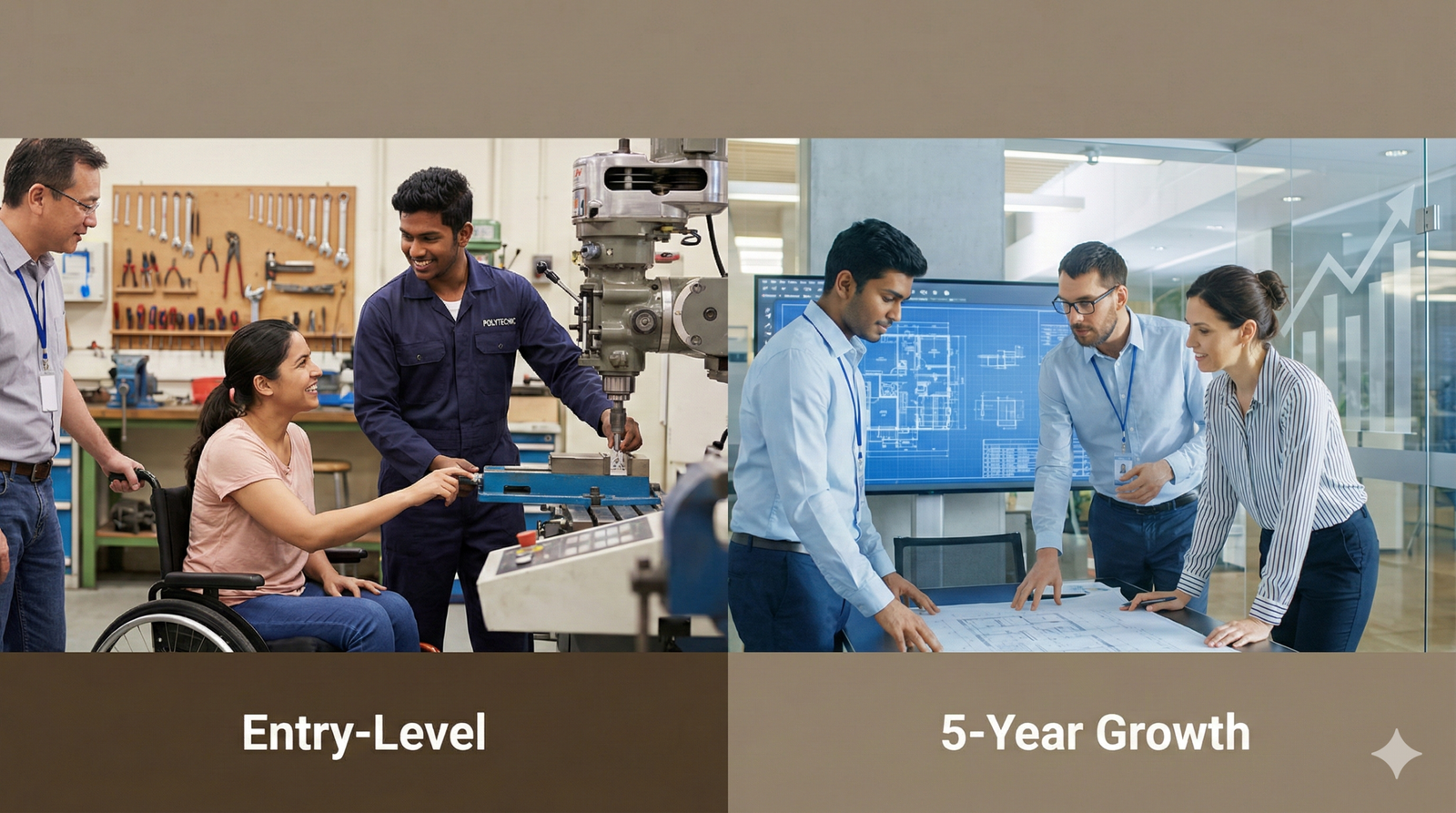
Entry-Level Reality: Most fresh diploma engineers in 2025 start with a stipend of ₹15,000–₹25,000 per month, not a full salary, due to the industry preference for apprenticeship models.
The “Degree Wall”: Without upskilling, diploma salaries typically plateau at ₹3.6–₹4.5 LPA after five years; however, acquiring niche skills like BIM (Civil) or PLC/SCADA (Electrical) can push this to ₹8–12 LPA.
New Upgrade Path: The AICTE-approved “B.Tech for Working Professionals” (not distance learning) now allows you to earn a regular degree while working, leveraging the National Credit Framework (NCrF) to bypass career stagnation.
1. Entry-Level Salary (2025): What is the Realistic Pay for Diploma Holders?
Direct Answer: In 2025, a fresh Diploma Engineer in a Tier-2 city can realistically expect a take-home stipend between ₹15,000 and ₹22,000 per month (₹1.8–₹2.6 LPA), while top-tier MNCs may offer up to ₹3.5–₹4.5 LPA.
The “average salary” of ₹6 LPA often cited online is misleading for freshers. The market reality for the Class of 2025 is stratified by designation:
Diploma Engineer Trainee (DET):
Role: Structured training in large MNCs (L&T, Tata Motors, Siemens).
Pay: ₹3.0 LPA – ₹5.0 LPA.
Growth: High conversion rate to permanent “Junior Engineer” roles after 12–18 months.
Multimodal Suggestion:
NATS Apprentice:
Role: Government-subsidized training scheme (1 year).
Pay: Statutory stipend of ₹8,000 – ₹12,000 (often supplemented by employers to reach ₹15k).
Risk: Many MSMEs use this as cheap labor and release candidates after one year.
Technician / Operator:
Role: Assembly line or maintenance roles in smaller units.
Pay: ₹12,000 – ₹18,000 per month.
Warning: Avoid staying here longer than 2 years; these roles often lack vertical career progression.
State-Wise Variation:
Maharashtra (Pune/Nashik): Higher median pay (₹20k–28k) due to automotive clusters.
Andhra Pradesh/Telangana: High placement volume but lower median pay (₹15k–18k) driven by bulk manufacturing.
Uttar Pradesh/Bihar: Lower private sector density; entry pay often dips to ₹10k–12k, driving heavy migration or govt job preparation.
2. The 5-Year Salary Growth: Stagnation vs. Specialization
Direct Answer: A generalist diploma holder will see linear growth to ₹35,000/month by Year 5, whereas a specialist (BIM/Automation) can cross ₹80,000/month in the same period.
The “5-Year Chasm” is where the gap between diploma and B.Tech holders widens. HR policies in structured corporate firms often cap diploma holders at the “Senior Supervisor” level, reserving “Assistant Manager” bands for degree holders.
The Linear Path (Stagnation)
Role: Site Supervisor, Maintenance Shift In-charge.
Year 5 Salary: ₹3.6 LPA – ₹4.8 LPA.
Ceiling: Hard to cross ₹6 LPA without a degree or 15+ years of tenure.
The “Skill Premium” Path (High Growth)
You can break the ceiling without a degree by mastering high-demand tools that B.Tech freshers lack.
| Branch | High-Value Skill | Year 5 Salary Potential | Why it pays? |
| Civil | BIM (Revit/Navisworks) | ₹8.0 – ₹12.0 LPA | Global outsourcing demand (US/UK projects). |
| Electrical | PLC/SCADA (Siemens/AB) | ₹10.0 – ₹15.0 LPA | Critical plant automation; shortage of skilled logic programmers. |
| Mechanical | NDT Level II / QA | ₹6.0 – ₹9.0 LPA | Specialized certification (ASNT) required for oil & gas/power sectors. |
Multimodal Suggestion:
3. B.Tech for Working Professionals: The Legal Upgrade (NEP 2025)
Direct Answer: AICTE now permits “B.Tech for Working Professionals,” a flexible regular mode degree (not distance) that allows you to work and study simultaneously if you have 1 year of experience.
This is the most significant policy shift for diploma holders. Unlike invalid “Distance B.Tech” degrees, this program is fully recognized for government jobs and higher education (GATE/M.Tech).
Key Rules (AICTE Approval Process Handbook 2024-25):
Eligibility: Diploma + Full-time employment + Minimum 1 Year Experience.
Geography Rule: Your workplace must be within 50km (75km in some states) of the institute.
Exception: NITTTR Chandigarh has a special exemption from the distance rule for its weekend batches, provided you attend physical classes.
Mode: Physical classes are held on evenings or weekends. It is NOT online/distance learning.
Credit Transfer: Under the National Credit Framework (NCrF), your diploma earns you credit points (Level 4.5), reducing the academic load required to reach the Degree level (Level 6.0).
Warning: Distance B.Tech is INVALID. The Supreme Court has ruled that engineering degrees cannot be obtained via distance mode. Do not fall for “fast-track” degree scams.
4. Government Jobs: SSC JE & RRB JE Salary Structure
Direct Answer: Central Government Junior Engineer (JE) posts offer a starting Gross Salary of ₹55,000 – ₹65,000 (Level 6 Pay Matrix), far exceeding private sector entry pay.
For students targeting stability, the government sector remains the gold standard.
SSC Junior Engineer (CPWD/CWC/MES):
Basic Pay: ₹35,400.
Allowances: DA (50%), HRA (up to 30% in X-cities), TA.
In-Hand: Approx. ₹55,000 – ₹60,000/month.
Railway (RRB) JE:
Growth: Faster promotion to Senior Section Engineer (SSE) compared to other departments.
5-Year Outlook: A JE promoted to SSE (Level 7) can earn ₹80,000+ per month within 6-8 years.
The Trade-off: The success rate is <1%. A dedicated preparation gap of 2-3 years can make you unemployable in the private sector if you fail to crack the exam.
5. Alternative High-Paying Career Paths
Direct Answer: Beyond core engineering, the Merchant Navy and specialized software roles offer salaries exceeding ₹1 Lakh/month within three years for diploma holders.
A. Merchant Navy (DME Course)
Pathway: 2-Year Diploma in Marine Engineering (DME) pre-sea training at DG Shipping approved institutes (e.g., IMS Goa, HIMT).
Entry Requirements: Diploma (Mech/Electrical) with 50% marks.
Salary: Starting salary as a Junior Engineer is $800–$1,500 USD (₹65k–₹1.2L) per month, tax-free.
Cost: The training is expensive (₹3–5 Lakhs).
B. Software / IT Lateral Shift
Pathway: Diploma (CS/IT) holders joining Wipro/TCS via “Scholar Trainee” programs (e.g., Wipro WILP).
Deal: They sponsor your M.Tech (from bits Pilani etc.) while you work.
Salary: Stipend starts low (₹15k) but jumps to ₹6–8 LPA upon completion of the 4-year tenure + M.Tech degree.
Ministry of Skill Development and Entrepreneurship (MSDE) – NSQF
FAQ: Common Questions from Diploma Students
Q: Can I do B.Tech via distance education while working?
A: No. Distance B.Tech is invalid for government jobs and top MNCs. You must enroll in an AICTE-approved “B.Tech for Working Professionals” program (evening/weekend classes) or a Part-Time B.Tech.
Q: Is a 3-year Diploma considered equivalent to 12th pass for government jobs?
A: Yes, for most central government exams (like SSC CHSL), a 3-year diploma is treated as equivalent to 10+2. However, for admission to general degree colleges (B.A./B.Sc), acceptance varies by university.
Q: What is the “Lateral Entry” advantage?
A: Diploma holders can take direct admission into the 2nd year of B.E./B.Tech. Under the new NCrF (2025), this is technically a “credit transfer” mechanism, acknowledging your previous learning hours.
Q: Which is better: 1 year of experience or immediate B.Tech?
A: If you can afford it, immediate B.Tech (Lateral Entry) is statistically better for long-term career growth. If financial constraints exist, work for 1-2 years, then use the “B.Tech for Working Professionals” route to avoid losing income.
Conclusion: The 2025 Strategy
The diploma is no longer a “terminal” qualification; it is a stackable credential. The old model of “Diploma -> Job -> Stagnation” is being replaced by “Diploma -> Job + Credits -> Degree.”
Your Action Plan:
Don’t Settle for Non-Technical Roles: Avoid “Operator” roles that don’t build engineering skills.
Bank Your Credits: Register on the Academic Bank of Credits (ABC) portal to ensure your diploma credits are recognized for future upgrades.
Specialization is Key: If you stay in the private sector without a degree, you must become a specialist (BIM, Automation, NDT) to survive the “5-Year Stagnation.”